
Private Spanish Tutoring in Bali
Spanish Tutoring in Bali: The Verbs Are the Wall
Spanish tutoring in Bali from Edupola pairs one teacher with one learner. Learners who studied alone arrive with the tables memorised and the conversation still stalling, so 6 facts about the verbs decide how the sessions run. Fees from IDR 197,300 per session.
Rating and fees for Spanish tutoring in Bali
| Programme | Spanish Tutoring in Bali |
|---|---|
| Provider | Edupola |
| Description | Private Spanish tutoring in Bali, one teacher per learner: the verbs are the wall, so they are drilled as a reflex and never as a memorised table. |
| Fee | Fees start from Rp197,300 per session. |
| Session Length | Sessions run 60, 90, or 120 minutes. |
| Schedule | Flexible, shaped around the learner's needs. |
| Start | Lessons begin once the tutor and materials are ready. |
| Sessions per Month | 4 to 28 sessions per month, as needed. |
| Rating | 4.9 out of 5, 125 reviews |
Programme at a Glance
Spanish Tutoring in Bali and Where the Wall Stands
Spanish tutoring in Bali runs one tutor with one learner, at your home, your workplace, or over a shared screen. This language is unusually generous at the start and then puts up one wall.
Spelling and sound line up almost perfectly, so reading aloud is reliable within weeks. Vocabulary is partly recognisable. Then the verbs arrive: endings that change with the person, two separate past tenses, two different verbs for being in a state, and a form used for requests and doubt that Indonesian handles with an extra word instead of a changed verb.
So the verbs are the programme. They are drilled as a timed reflex, with a small number of them repeated across many situations, because a table you can recite does not reach the speed a conversation needs. Fees start from IDR 197,300 per 60-minute session, with 4 to 28 sessions a month. This programme holds a 4.9 out of 5 rating across 125 learner reviews in Bali.
Varieties
Spanish Varieties and the Choice You Have to Make
The choice is settled in the first session. It is not a matter of correctness, and leaving it unsettled is what costs months.
| Point | European Spanish | Latin American Spanish |
|---|---|---|
| The plural form of address | Uses a familiar form for a group of people | Uses the respectful form for everyone |
| The sound of some letters | Some letters are pronounced more thinly | Pronounced the same as another similar letter |
| Everyday vocabulary | Some words particular to Europe | Some words particular to each country |
| What the DELE exam requires | Both are accepted | Both are accepted |
| Suits | Learners aiming at study or work in Europe | Learners serving guests or trading with Latin America |
| What this programme trains | Follows the learner's goal, settled in the first session | Follows the learner's goal, settled in the first session |
The Verbs
Six Facts About the Verbs That Decide Progress
Each item below is a reason learners stall. They are the working content of Spanish tutoring in Bali.
-
The Form Follows the Person
The ending of the verb changes with who is doing it, so the pronoun often does not need saying. Learners who keep saying the pronoun sound correct and foreign at the same time.
-
Few Verbs, Many Repetitions
Practice uses a dozen or so of the most frequent verbs, repeated across many situations. Adding new verbs is postponed until those forms arrive without thinking.
-
Two Past Tenses
There are two ways to speak about the past, and the choice depends on whether the action was completed or ongoing. This is the part that takes the longest to settle.
-
Two Verbs for a State
Two different verbs are used to say what something is, and the choice changes the meaning of the sentence. Learners practise choosing through pairs of sentences instead of through a rule.
-
The Form for Requests and Doubt
One particular form carries requests, hopes, and doubt. It feels alien to Indonesian learners, because Indonesian handles all three with an added word and leaves the verb untouched.
-
The Irregular Verbs
Several of the most frequently used verbs are exactly the ones whose forms depart from the pattern. They are memorised first, because they appear in almost every sentence.
Learning Path
The Order of Material in Spanish Lessons
The starting stage in Spanish is set in the first session, by reading a few sentences aloud and building one sentence in the past tense.
-
Stage 1
Reading Aloud and the Present
The letter to sound relationship is fixed first, and it finishes quickly because the rules are regular. Alongside it, the present-tense forms of the most frequent verbs.
- Regular spelling
- Present tense
- Frequent verbs
-
Stage 2
The Two Past Tenses
The two ways of speaking about the past are introduced side by side instead of one after the other. Learners choose between them inside their own stories.
- Side by side
- Your own stories
- Completed or ongoing
-
Stage 3
Fast Speech and Listening
Recordings of real conversation enter at natural speed, in the variety the learner chose. This stage also shows which words that variety actually uses.
- Natural speed
- Your chosen variety
- Real vocabulary
-
Stage 4
Requests and Writing
The form for requests, hopes, and doubt is drilled in real situations: asking permission, bargaining, making a complaint. Writing follows the learner's goal.
- Real situations
- Asking permission
- Writing to goal
Who It Is For
Learners Who Take Spanish Lessons in Bali
Every session holds one learner, so the variety and the situations come from that learner's work.
-
Hotel and Villa Staff
Learners in Bali receiving Spanish-speaking guests. Service sentences are drilled whole, and the Latin American variety is usually the one chosen.
-
Tour Guides
Learners in Bali explaining places and answering on the spot. Listening is drilled hardest, since guests speak fast and ask unexpected things.
-
Handicraft Traders
Learners in Bali selling crafts to buyers in Latin America or Spain. Bargaining and trade correspondence take the larger share.
-
Prospective Students
Learners in Bali aiming at study or a scholarship there. Writing and long-form reading come first, usually in the European variety.
-
Remote Freelancers
Learners in Bali working for an employer in a Spanish-speaking country. Meeting conversation and written messages are the targets.
-
Cooks and Restaurant Staff
Learners in Bali cooking or serving in a restaurant. Ingredient words, cooking methods, and allergy questions come first.
One Session
Inside a 60-Minute Spanish Session
This is the division used once the present tense is secure. The first block is timed, and the timing is the point of it.
-
10 minutes
Fast Drill on Verb Forms
The teacher names a person and a tense, the learner answers the form with no writing and no pause. What is measured is the speed, because speed is the thing a conversation needs.
-
10 minutes
A Story About the Learner's Day
The learner tells their day using both past tenses. The same exercise recurs every session with a different day, so the choice between the two becomes automatic.
-
25 minutes
One Situation Played Out
A situation from the learner's work is played in full: receiving a guest, bargaining on a price, or explaining a menu. The teacher takes the other part.
-
10 minutes
Listening in the Chosen Variety
A recording in the variety the learner picked is played twice: once for the gist, once for the detail.
-
5 minutes
Setting the Daily Drill
The teacher sets a fast verb drill for each day, small in quantity and repeated, because a reflex grows out of frequency instead of length.
A 90 or 120 minute session holds two situations, or one situation plus a written task, and the verb drill still stays in. Learners preparing a DELE certificate usually pick that.
Prepared by the Learner
What to Have Ready Before the First Session
Headphones you already use, and a small notebook are prepared by the learner and not included in the fee. The admin confirms the list once the schedule for Spanish tutoring in Bali is agreed.
-
The Variety You Are Aiming At
Europe or Latin America. The choice changes the plural form of address and some vocabulary, and settling it at the start avoids relearning both later.
-
The Work Situations You Face
Write down what you face every day: receiving guests, explaining a menu, bargaining on price, or remote meetings. Those situations become the conversation material.
-
One Film or Programme
One film, series, or broadcast from the variety you chose. It becomes listening material, and choosing from your own variety keeps the vocabulary consistent.
-
Your Own Headphones
The headphones you normally use, because the daily practice happens on them too. An ear used to one device notices small differences sooner.
-
A Notebook for the Drill
One small book for noting verbs and the forms that still trip you. That list is read before the fast drill each session, so the drill targets what is weak.
If you are unsure which variety to choose, say so during the consultation. The work you do usually settles it, and the teacher explains what each choice changes.
Method
Verb Forms Are Drilled as a Reflex
Almost every learner who studied alone arrives with the same thing: the verb tables memorised, and a conversation that still stops in the middle. The two are not contradictory. Memorising a table gives you the forms when you have time to look them up in your head, and a conversation does not give you that time.
So practice in Spanish tutoring in Bali uses the opposite shape to a table: few verbs, many repetitions, and always timed. The teacher names a person and a tense, the learner answers immediately, and the pace is kept high enough that there is no room to reason it out. When an answer needs reasoning, that verb goes on the list for tomorrow.
The practical consequence shows in the second month. Learners who drill this way can hold a conversation with fewer words than learners who memorised tables, and the conversation runs. Vocabulary is the easier half to add later; the reflex is the half that has to be built by repetition.
What Learners Say
Stories From Spanish Learners in Bali
The quotes below come from learners in Bali who completed the Spanish programme at Edupola, with their situation and what changed.
-
★★★★★
I studied Spanish at Edupola to deal with guests from Latin America at the hotel where I work. A native speaker tutor got me used to the pronunciation and the conversation quickly. I have now passed DELE B2!
Passed DELE B2
Ayu L.
Staff at an international hotel · Verified learner
-
★★★★★
Many of my buyers are from Mexico and Colombia. After lessons at Edupola I can negotiate directly in Spanish with no interpreter. Export revenue is up because the communication runs more smoothly.
Can negotiate business in Spanish
Dharma P.
Balinese handicraft exporter · Verified learner
-
★★★★★
The Edupola tutor helped me prepare DELE C1 for a scholarship requirement. The method is very structured, from gramatica through to expresion oral. Praise be to God, I got the scholarship to Spain!
Scholarship to the Universidad de Salamanca
Ratna D.
Literature student · Verified learner
-
★★★★★
As a guide in Bali, many visitors come from Spain and Latin America. Spanish lessons at Edupola mean I can give a tour in espanol. My rating on the platform has risen sharply!
Serving Spanish-speaking visitors
Agus N.
Tour guide in Bali · Verified learner
-
★★★★★
I was preparing to move to Barcelona for remote work. Edupola took me from nothing to level B2 in 8 months. Now I can handle everyday conversation and administrative business in Spain.
Living and working remotely in Barcelona
Intan P.
Digital nomad · Verified learner
-
★★★★★
I wanted to go deeper into cocina espanola for my restaurant. The Edupola tutor taught Spanish in a culinary context. Now I can read original recipes and talk with the Spanish chefs in my network.
Understands Spanish recipes and culinary technique
Oka W.
Chef at an international restaurant · Verified learner
Varieties
Choosing a Variety Early Saves Months Later
This language is used across many countries, and the differences between its varieties are real on two points that come up constantly: the form used to address a group of people, and the sound of a few letters. Neither one will make you misunderstood, and both will make you sound as though you learned from two places at once.
In Spanish tutoring in Bali the choice is usually obvious as soon as the learner's work is named. Hotel staff and tour guides serve guests from many Latin American countries, so that is the variety trained. Learners aiming at study, a scholarship, or administrative business in Spain learn the European variety, and the DELE exam accepts either.
What is worth avoiding is letting the varieties mix unintentionally, for instance learning from films in one variety while the teacher uses another. That mixture is not fatal and it does slow things down, because the learner hesitates at exactly the forms that come up most often. Settling it in the first session costs a minute and saves a term.
How to Register
Four Steps to the First Spanish Session
The opening consultation carries no fee. The admin asks which variety you need and what situations you face.
-
Name the Variety and the Situations
The variety you are aiming at and the situations you face each day. Both decide the vocabulary and the form of address trained.
-
Agree the Schedule
Days, times, session length, and sessions per month are agreed with the admin, following the short daily verb drill, which matters more here than a long weekly session; learners on rotating shifts usually book fortnightly blocks.
-
Matching the Teacher
The team looks for a tutor whose travel to your location in Bali stays short, and that search runs 1 to 5 working days. The variety decides this, since a teacher trains the form of address they use themselves.
-
The First Session
You read a few sentences aloud and build one present and one past sentence, then the starting level and the daily drill are set.
Need help? Contact our admin on WhatsApp for a free consultation.
Documentation
Spanish Lessons With Edupola in Bali
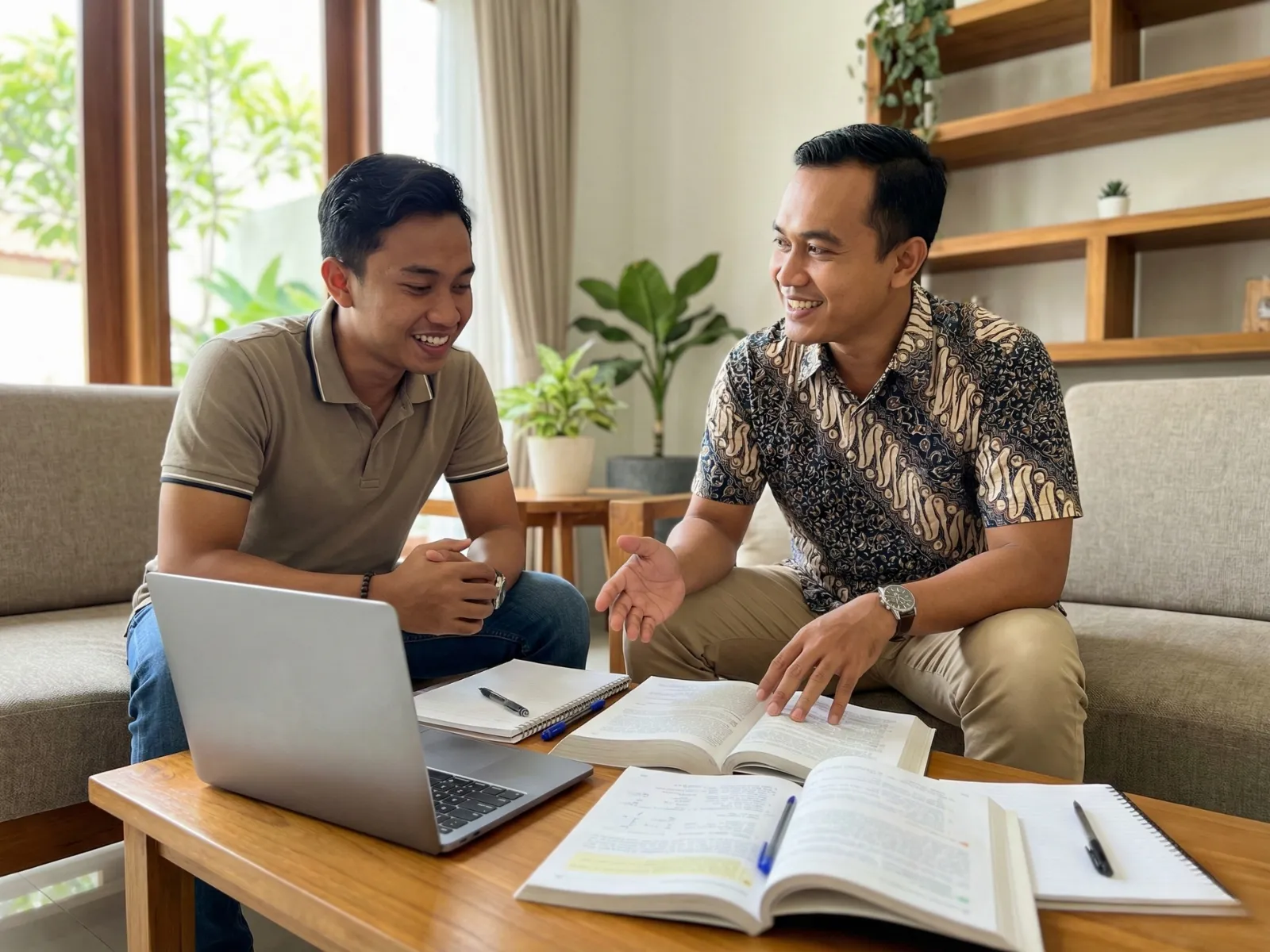
The photographs below were taken during Spanish tutoring in Bali sessions with learners on the island.




Service Area
Where Edupola Spanish Teachers Travel in Bali
Tutors for Spanish tutoring in Bali travel to the location you choose, from Denpasar, Badung, and Gianyar through to Tabanan, Buleleng, Klungkung, Bangli, Karangasem, and Jembrana. What has to be there is seating that faces, because the fast drill is spoken back and forth with no pauses.
The workplace shapes scheduling here more than the hour does. Many learners work in the tourist areas of Badung and Gianyar and ask for sessions in the gaps in their shifts, so the admin asks about the quiet hours there before a teacher is matched.
The Edupola office is not used as a lesson venue. Where no tutor is available near you, sessions run online. For this programme that route works on near-equal terms, with one caveat covered in the next section. Ask the admin about teacher coverage at your location in Bali.
Online Sessions
Online Spanish Sessions and Drilling Back and Forth
Online sessions for Spanish tutoring in Bali run over Zoom or Google Meet, and the greater part of this programme runs on equal terms there. The fast verb drill, the daily story, and the situation conversation all need nothing but two people and sound.
One thing deserves attention: the drill is spoken back and forth with very short gaps, and network delay can add half a second to every answer. Half a second matters here, because speed is what is being measured, so teachers on this route either hold the drill slightly slower and say so, or move it to recorded answers the learner sends between sessions.
One thing is easier online: listening to material from the learner's chosen variety. The broadcast opens on the learner's own screen and a confusing part can be repeated several times without waiting. Fees for online sessions match face-to-face sessions.
Frequently Asked
Questions From Spanish Learners in Bali
What does private Spanish tutoring in Bali cost?
Fees start from IDR 197,300 for a 60-minute session, the shortest option. Sessions of 90 and 120 minutes are available with the fee following the length. The final fee follows session length and the number of sessions per month, between 4 and 28. The admin sends the breakdown in writing before the first payment. Headphones you already use, and a small notebook are prepared by the learner and not included in the fee.
I have memorised the verb tables and still stop when I speak. Why?
Because a table gives you forms when you have time to search for them, and conversation does not give you that time. The fix is a timed drill on a dozen frequent verbs, repeated until the form arrives without reasoning. Learners usually feel the difference in the second month, and they feel it with fewer words than they had before.
Which variety should I learn?
The one your listeners use. Hotel staff and guides in Bali mostly serve visitors from Latin American countries, so that is usually the choice; learners heading for study or administrative business in Spain learn the European variety. The DELE exam accepts either, so the certificate is not the deciding factor.
How long before I can serve a guest in basic conversation?
Learners handling basic service exchanges within a few months is common, because this language rewards early reading aloud and service sentences can be drilled whole. What takes longer is understanding the answer when a guest speaks quickly, which is a listening skill and not a speaking one. So listening enters from the third stage instead of being left to the end.
Do I need to take a DELE certificate?
Only if a file requires it, such as a scholarship or a university place. Learners without that requirement skip the exam material and put the time into conversation and listening, which get used sooner at work. The level each institution asks for differs, so that is the first thing to check before preparing for one.
How is a Spanish teacher matched to a learner?
The schedule is settled first during the consultation, covering days, times, session length, and sessions per month. The Edupola team then looks for a tutor whose travel to your location in Bali stays short, and that search runs 1 to 5 working days. The variety matters here: a teacher trains the form of address they use themselves, so the match follows the variety you need. If the first 2 weeks feel like a poor fit, a replacement is arranged at no extra cost.
Related Programmes
Other Programmes Learners Add in Bali
Learners taking Spanish tutoring in Bali often add one other programme, usually once service conversation is steady.
-

Korean Tutoring in Bali
Taken by hospitality staff whose regular guests come from two different regions.
-
Public Speaking Tutoring in Bali
A choice for tour guides who have to explain in front of a large group.
-
Romanian Tutoring in Bali
Often taken by learners using a Romance-language footing for business in Eastern Europe.
Get Started
Start From the Situations You Face Each Day
Name the variety you need and the situations you deal with at work. A tutor in Bali is matched within 1 to 5 working days.