
Private Regional Language Tutoring in Bali
Regional Language Tutoring in Bali: Marked on the Exam Paper
Regional language tutoring in Bali from Edupola pairs one tutor with one pupil at home. Families arrive puzzled: the child speaks Balinese daily and the mark stays low. The 6 things a teacher actually marks are mostly written, and the script is where the marks are lost. Fees from IDR 96,000 per session.

Rating and fees for regional language tutoring in Bali
| Programme | Regional Language Tutoring in Bali |
|---|---|
| Provider | Edupola |
| Description | Private regional language tutoring in Bali for the school subject: Balinese script letter forms, conjunct letters, transliteration both ways, proverbs, speech levels, and spoken work. |
| Fee | Fees start from Rp96,000 per session. |
| Session Length | Sessions run 60, 90, or 120 minutes. |
| Schedule | Flexible, shaped around the learner's needs. |
| Start | Lessons begin once the tutor and materials are ready. |
| Sessions per Month | 4 to 28 sessions per month, as needed. |
| Rating | 4.9 out of 5, based on 118 reviews |
Programme at a Glance
Regional Language Tutoring in Bali and What Schools Mark
Regional language tutoring in Bali runs one tutor with one learner, at your home, your workplace, or over a screen. The puzzle that brings most families here is worth stating first: a child who speaks Balinese with their grandparents every day comes home with a low mark in the subject.
There is no contradiction. The subject is assessed mostly in writing, and the writing is in Balinese script: letter forms, the conjunct letters that join inside words, and transliteration in both directions. A fluent speaker who cannot form the characters loses those marks entirely, and spoken work is usually the smallest part of the paper.
So the programme follows what the teacher marks, in the order the school meets it, using the pupil's own textbook and their last marked paper. Fees start from IDR 96,000 per 60-minute session, with 4 to 28 sessions a month. This programme holds a 4.9 out of 5 rating across 118 learner reviews in Bali.
By School Level
What Each School Level in Bali Demands
Regional language tutors use this to place a pupil against what their own school is asking. The third column is the complaint that usually arrives with that level.
| School level | What the school demands | The complaint that comes with it |
|---|---|---|
| Lower primary | Recognising characters and copying them | Characters drawn from memory in roughly the right shape |
| Upper primary | Writing words with conjunct letters | The alphabet learned as separate shapes, so joined words collapse |
| Junior secondary | Transliteration both ways and proverbs | One direction fluent and the other barely attempted |
| Senior secondary | Longer texts and classical literature | Reading possible, meaning and context missing |
| Competition and olympiad | Speed, accuracy, and literary knowledge | Exam preparation mistaken for competition preparation |
| Pupils arriving from elsewhere | Catching up a subject taught for years | Starting mid-syllabus with no foundation in the script |
What Is Marked
Six Things Teachers Check in This Subject
These come straight from marked papers collected in regional language tutoring in Bali. The order below is roughly the order marks are lost in.
-
Letter Forms in Balinese Script
Each character has a fixed shape with a stroke order, and a character drawn approximately is marked wrong. This is where the largest share of marks goes, and it is pure practice.
-
Conjunct Letters Inside Words
Characters change shape when they join inside a word. Pupils who learned the alphabet as separate shapes meet this and stall, because the rule is not visible from the individual letters.
-
Transliteration Both Ways
Latin into script and script back into Latin. Most pupils can do one direction comfortably and lose marks on the other, and exam papers ask for both.
-
Proverbs and Their Meanings
Set expressions with meanings that do not follow from the individual words. Memorising the words without the meaning fails the question, since the question asks for the use.
-
The Correct Speech Level
Choosing refined or everyday forms according to who is being addressed in the question. Pupils who speak only everyday Balinese at home lose these marks consistently.
-
Spoken Work
Reading aloud or a short conversation, usually the smallest part of the mark. It is also the part fluent pupils already hold, which is why their total still disappoints.
Learning Path
The Order of Material From Letter Forms to Literature
The regional language stage a pupil starts at is set by their last marked paper, and never by their school year.
-
Stage 1
Letter Forms That Hold
Each character written by hand with its stroke order until the shape is stable without a model. Slow and unavoidable, and it is where the largest share of marks sits.
- Stroke order
- Written without a model
- One group at a time
-
Stage 2
Conjunct Letters and Whole Words
How characters change when they join, practised in real words instead of in isolation. Pupils who stalled at school usually stalled exactly here.
- Joining rules
- Real words
- Reading back your own writing
-
Stage 3
Transliteration and Proverbs
Both directions drilled separately, since each has its own difficulty, plus proverbs learned with their use instead of their literal words.
- Both directions
- Proverbs in use
- Exam-shaped questions
-
Stage 4
Long Texts and Literature
Longer passages, classical verse, and palm-leaf manuscripts for pupils who need them. Context and meaning carry the marks at this level, not decoding.
- Longer passages
- Classical verse
- Meaning and context
Who It Is For
Pupils Who Take Regional Language Lessons in Bali
Every session holds one learner, so the material follows that pupil's own school syllabus and marked papers.
-
Primary Pupils Meeting the Script
Pupils in Bali seeing Balinese characters for the first time. Stroke order and letter forms carry every session, written by hand.
-
Junior Secondary Pupils Whose Marks Fell
Pupils in Bali whose marks dropped when conjunct letters arrived. The first session finds the exact rule that was missed.
-
Senior Secondary Pupils Facing Literature
Pupils meeting classical verse and longer texts. Weight goes to meaning and context, since decoding alone no longer earns marks.
-
Competition and Olympiad Entrants
Pupils in Bali with a contest date. Speed, accuracy, and literary knowledge are trained differently from exam preparation.
-
Pupils Who Moved to Bali
Pupils joining mid-syllabus in a subject taught for years. Sessions build the script foundation while keeping up with the current chapter.
-
Parents Who Want to Help
Parents in Bali who cannot read the script their child is set as homework. Sessions cover enough for a parent to check the work.
One Session
Inside a 60-Minute Regional Language Session
This is the division used once letter forms are under way. The block where the pupil writes without a model is never skipped.
-
10 minutes
Checking Last Week's Writing
The sheets written since the last session are read, with the tutor looking for one repeated error instead of marking everything.
-
15 minutes
One New Rule
A single rule: one group of characters, one conjunct form, or one proverb. One per session, because two leaves neither usable in an exam.
-
15 minutes
Writing Without a Model
The pupil writes the same characters with the example covered. Copying is comfortable and proves nothing, and the exam offers no model.
-
15 minutes
Exam-Shaped Questions
Questions in the form the school actually uses, taken from the pupil's own textbook or a past paper, answered under the real time.
-
5 minutes
Setting the Home Practice
A short written practice, with the next assessment date noted so the sessions stay aimed at it.
In a 90 or 120 minute session, a full past paper is sat under time and then marked together, which is what learners with an assessment close usually choose.
Prepared by the Family
What to Have Ready Before the First Session
The admin confirms these once the schedule for regional language tutoring in Bali is agreed. Textbooks, exercise books, and pencils are prepared by the learner and not included in the fee.
-
The Textbook From School
The actual book the class uses, since schools in Bali differ in order and emphasis. Teaching from a different book produces a pupil who is well taught and still unprepared for their own paper.
-
The Last Marked Paper
Marked, with the teacher's corrections visible. It is the single most useful document in the first session, because it shows precisely where the marks were lost.
-
One Sheet of Their Script Writing
Anything your child has written in Balinese characters. Letter forms and stroke habits are visible immediately, and they decide where the sessions start.
-
An Exercise Book and Pencils
Written by hand, not typed. The subject is assessed by hand, and the motor habit of forming each character is the thing being built.
-
The Next Assessment Date
When the next test or report falls. The sessions are planned backwards from it, so the material arrives in the order the paper needs.
If the last paper has gone missing, say so during the consultation. The first session then uses a sample paper instead, which costs one session of diagnosis.
The Puzzle
Speaking Fluently and Scoring Well Are Two Different Things
This is the most common conversation in regional language tutoring in Bali, and it deserves a direct answer. A child who speaks Balinese with their family all day can score poorly in the subject, and nothing is wrong with either their language or their intelligence.
The subject is assessed in writing. Spoken work is usually the smallest component, while letter forms, conjunct letters, and transliteration carry most of the paper. Those are literacy skills in a script the child may never have written outside school, and fluency in speech transfers to none of them automatically.
There is a second half that families find harder to hear. Many households speak the everyday form, while the paper asks for the refined form in situations where it is required. A pupil who answers naturally, in the register they use at home, is marked wrong on a question that was testing register. Those marks come back quickly once the pairs are drilled, which is why the first session reads the marked paper instead of testing the pupil.
Competitions
Competition Preparation Is Not Exam Preparation
Families sometimes ask for both at once, and regional language tutoring in Bali separates them because the two pull in different directions. An exam rewards covering the whole syllabus to a reliable standard. A competition rewards depth in a narrow band, speed, and accuracy under pressure, and the syllabus is not the boundary.
In practice that changes what a session contains. Exam preparation works through the chapters the school will assess, in order, with past papers in the real format. Competition preparation drills speed on script, memorised proverbs and verse, and literary knowledge beyond the textbook, usually with a timer running.
A pupil can do both, in sequence instead of simultaneously, and the honest sequencing is to secure the exam material first. A pupil who prepares only for a competition can take a medal home and still see their report mark fall, which is a result no family wants and one that is foreseeable from the start.
What Families Say
Stories From Pupils and Families in Bali
The quotes below come from learners in Bali who completed the regional language programme at Edupola, with their situation and what changed.
-
★★★★★
I used to find the Balinese script very hard and now I read and write it fluently. My Edupola tutor was patient and the lessons were enjoyable.
Balinese marks up from 70 to 92
Ayu P.
Year 8 junior secondary pupil · Verified learner
-
★★★★★
As someone living in Bali I wanted to learn the local language. My Edupola tutor is very patient and makes it enjoyable. I can greet my neighbours in Balinese now.
Basic conversation within 2 months
Michael J.
Expatriate from Australia · Verified learner
-
★★★★★
My child was prepared for the district-level Balinese language olympiad. The Edupola tutor is very strong on literature and the script. She took second place.
Child qualified for the Balinese language olympiad
Wirawan
Parent of a primary pupil · Verified learner
-
★★★★★
I learned Balinese to communicate better with my staff and neighbours. Our relationships are closer now that we can talk in their own language.
Communicating comfortably with local staff
Sarah C.
Business owner in Ubud · Verified learner
-
★★★★★
I wanted to go deeper into classical Balinese literature. My Edupola tutor taught me to read lontar manuscripts and understand geguritan. Genuinely valuable knowledge.
Able to read palm-leaf manuscripts
Sudiarta
Literature undergraduate · Verified learner
-
★★★★★
I married into a Balinese family and wanted to understand the language of ceremony. I can follow the family rituals and understand the prayers now.
Able to follow customary ceremonies
Jessica T.
Parent at home · Verified learner
How to Register
Four Steps to the First Regional Language Session
The opening consultation carries no fee. The admin asks your child's school level and when the next assessment falls.
-
Name the School Level and the Deadline
The year your child is in and the date of the next test or report. Those two decide the order of the material, and a competition date is noted separately.
-
Agree the Schedule
Days, times, session length, and sessions per month are agreed with the admin, following the hours your child can give to short written practice between sessions.
-
Matching the Tutor
The team looks for a tutor whose travel to your location in Bali stays short, and that search runs 1 to 5 working days. Pupils aiming at an olympiad are matched with a tutor who reads classical literature.
-
The First Session
The last marked paper is read, one sheet of script writing is examined, and the starting stage is set from what the marks show.
Need help? Contact our admin on WhatsApp for a free consultation.
Service Area
Where Edupola Regional Language Tutors Travel in Bali
Tutors for regional language tutoring in Bali travel to the location you choose, from Denpasar, Badung, and Gianyar through to Tabanan, Buleleng, Klungkung, Bangli, Karangasem, and Jembrana. A table, good light, and the pupil's own textbook are what the session needs, since the work is written by hand throughout.
One thing is specific to this subject: schools differ in which chapters they reach and in how strictly they mark letter forms, so a tutor who knows the local schools is worth more than one further away who does not. Pupils preparing for a district competition are matched for that district where possible, because the papers differ.
The Edupola office is not used as a lesson venue. Where no tutor is available near you, sessions run online. Part of this subject transfers online and part does not, as the next section explains. Ask the admin about tutor coverage at your location in Bali.
Documentation
Regional Language Lessons With Edupola in Bali
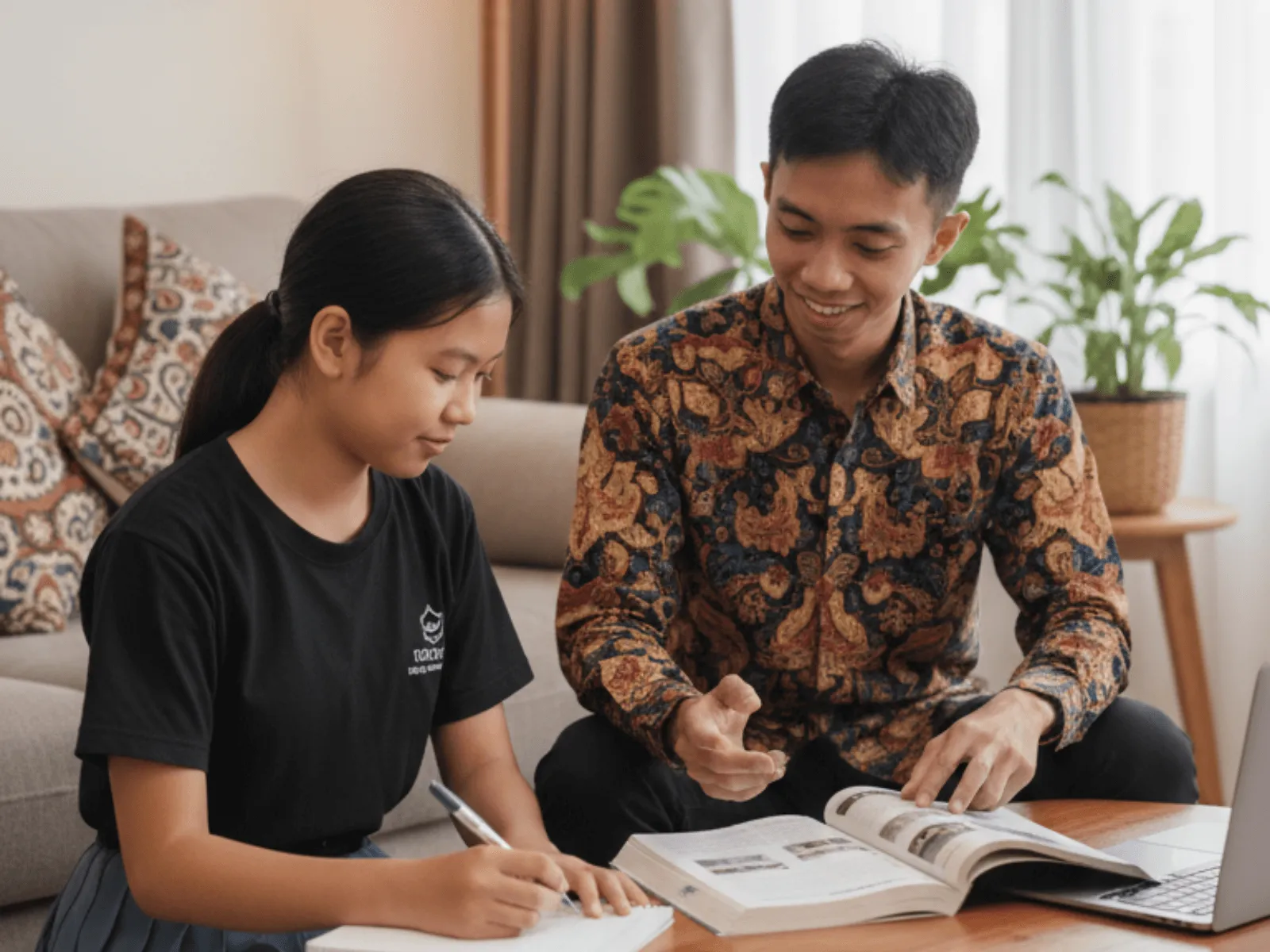
The photographs below were taken during regional language tutoring in Bali sessions with learners on the island.




Online Sessions
Online Regional Language Sessions in Bali and Their Limits
Online sessions for regional language tutoring in Bali run over Zoom or Google Meet, and this subject divides cleanly. Transliteration, proverbs, reading, and exam-shaped questions all transfer without loss, and the written notes a pupil keeps from an online session are often better than their handwritten ones.
Letter forms are the part that needs care, because stroke order has to be watched as it happens. The arrangement is a camera above the page, angled at the hand, so the tutor sees the sequence instead of the finished character. Without that view a tutor is marking the result and missing the habit that produced it.
Pupils preparing for an olympiad usually keep the literature sessions online and the script sessions face to face. Fees for online sessions match face-to-face sessions.
Frequently Asked
Questions From Families in Bali
What does private regional language tutoring in Bali cost?
Fees start from IDR 96,000 for a 60-minute session, the shortest option. Sessions of 90 and 120 minutes are available with the fee following the length. The final fee follows session length and the number of sessions per month, between 4 and 28. The admin sends the breakdown in writing before the first payment. Textbooks, exercise books, and pencils are prepared by the learner and not included in the fee.
My child speaks Balinese fluently at home. Why is the mark low?
Because the subject is assessed in writing and the writing is in Balinese script. Letter forms, conjunct letters, and transliteration carry most of the paper, and none of them follow from being able to speak. There is a second cause too: many households use the everyday form while the paper asks for the refined form where it is required, and answering naturally is marked wrong on a register question.
Is this programme also for pupils who moved to Bali?
Yes, and it is a common case. A pupil arriving in year 5 or year 8 is joining a subject that has been taught since the first year of school, so sessions do two things at once: build the script foundation from the beginning and keep up with the chapter the class is on. The split between the two is set from the next assessment date.
How long before the mark changes?
Letter forms respond quickly, usually within a handful of sessions, because the problem is practice and not understanding. Conjunct letters take longer since the rules have to be learned and then used. Transliteration in the weaker direction is the slowest. A realistic answer for most pupils is one reporting period, and the tutor says plainly whether the next date is reachable.
Will the tutor do my child's homework?
No. Homework stays the pupil's work, and a tutor who completes it removes the only honest signal the teacher has. What happens instead is that the homework is used as material: the pupil attempts it, the tutor reads the attempt, and the rule behind the mistake is taught. That is slower in one evening and faster across a term.
How is a tutor matched to a pupil?
The schedule is settled first during the consultation, covering days, times, session length, and sessions per month. The Edupola team then looks for a tutor whose travel to your location in Bali stays short, and that search runs 1 to 5 working days. Local knowledge matters here, since schools differ in which chapters they reach, and olympiad candidates are matched with a tutor who reads classical literature. If the first 2 weeks feel like a poor fit, a replacement is arranged at no extra cost.
Related Programmes
Other Programmes Pupils Add in Bali
Families taking regional language tutoring in Bali often add one other programme, usually because the gap is wider than the subject.
-

Balinese Language Tutoring in Bali
Taken by learners who want to speak the language instead of sitting the subject.
-

Handwriting Tutoring in Bali
Chosen when letter forms are unsteady because the hand itself is not ready.
-
Primary School Tutoring in Bali
Often added when several school subjects need support at once.
Get Started
Start From Your Child's Last Marked Paper
Tell us the school level, the next assessment date, and what the last marked paper shows. A tutor in Bali is matched within 1 to 5 working days.