
Private Coding Lessons for Children in Bali
Coding for Children in Bali: Blocks Into Typed Code
Coding lessons for children in Bali from Edupola pair one tutor with one child at home. Nearly every child enjoys dragging blocks, and a predictable share stop within 2 sessions of meeting typed code. That crossing is what this programme is built around. Fees from IDR 174,100 per session.
Rating and fees for coding lessons for children in Bali
| Programme | Coding Lessons for Children in Bali |
|---|---|
| Provider | Edupola |
| Description | Private coding lessons for children in Bali, one tutor per child. Block coding first, then the crossing into typed code, with keyboard practice trained separately. |
| Fee | Fees start from Rp174,100 per session. |
| Session Length | Every session runs 60, 90, or 120 minutes. |
| Schedule | Flexible, following the learner's free hours. |
| Start | Enrolment is open year round. |
| Sessions per Month | 4 to 28 sessions per month, as needed. |
| Rating | 4.9 out of 5, based on 133 reviews |
Programme at a Glance
Coding Lessons for Children in Bali and Where Children Usually Stop
Coding lessons for children in Bali runs one tutor with one learner, at your home, your workplace, or over a screen. The programme is organised around one predictable moment, and parents deserve to know it in advance because it looks like a loss of interest.
Block coding is enjoyable from the first minute: drag, click, and something moves on screen. Typed code asks for three new things at once, which is exactly why it stalls children. Every character has to be correct, nothing happens until it is, and a single mistyped bracket produces an error message written for adults.
So the crossing is taken in stages instead of in one lesson, and typing on a keyboard is trained as a separate skill. The material runs from blocks through to typed code, with the child's own project as the thing being built the whole way. Fees start from IDR 174,100 per 60-minute session, with 4 to 28 sessions a month. This programme holds a 4.9 out of 5 rating across 133 learner reviews in Bali.
The Crossing
Six Ways the Gap From Blocks to Typed Code Is Crossed
These are used from the sessions where a child first meets typed code in coding lessons for children in Bali. None of them involve starting over.
-
Reading Their Own Programme First
Before typing anything, the child explains out loud what their block programme does, step by step. Typed code is easier to accept when it is describing something they already built.
-
Blocks and Text Shown Together
The same instruction displayed as a block and as a line of code, side by side. The child sees a translation instead of a new subject, which changes how willing they are to try.
-
Typing Fragments, Not Whole Programmes
The tutor supplies most of the code and leaves one line, then two, for the child to type. Typing a whole programme at this stage produces twenty errors and no understanding.
-
Typing Mistakes Used as Material
A misspelled command becomes the lesson: read the message, find the line number, fix one thing. Children who learn this stop asking an adult for every error.
-
Keyboard Practice Kept Separate
Finding brackets and colons is a motor skill and it is drilled on its own, away from any programme. A child hunting for a symbol has no attention left for the logic.
-
Going Back to Blocks When Needed
A child who stalls returns to blocks for a session without it being treated as failure. Progress in this subject is not linear, and forcing the crossing is what makes children quit.
By Age
Coding Levels From Age 6 to 15
The coding level a child starts at is set by what they can already build, and age is only a rough guide. Reading fluency matters more than age, since typed code has to be read.
-
Ages 6 to 8
Blocks and Sequence
Dragging blocks to make something move, with the idea of order: this happens, then this. Sessions end with something the child can show a parent, every time.
- Order of steps
- Something that moves
- Shown to a parent
-
Ages 9 to 11
Loops, Choices, and a Finished Project
Repetition and conditions inside blocks, built into a game or an animation the child chose. This is where most children in the programme spend the longest, and rightly so.
- Loops and conditions
- A project they chose
- Finishing it
-
Ages 12 to 15
Typed Code
The crossing into Python, in fragments, with keyboard practice alongside. Error messages are read together from the first one, since reading them is the actual skill.
- Python in fragments
- Reading error messages
- Keyboard practice
-
Any age
Their Own Work and Showing It
A project of the child's own choosing, finished and then explained to someone else. Explaining it turns out to matter as much as building it, and shy children gain the most here.
- Their own idea
- Finished, not perfect
- Explained out loud
Tool Map
Tools Used and the Limit of Each One
Coding tutors use this to choose where a child starts. The third column is the honest part: each tool has a point where staying in it stops teaching anything new.
| Tool | What it teaches | Limit and when to leave it |
|---|---|---|
| Block coding on screen | Order, loops, conditions, events | Hides spelling and structure; leave once loops and conditions are easy |
| Block coding with a robot | The same logic with a physical result | Needs equipment, and the equipment becomes the lesson if it misbehaves |
| Python for children | Typed code with short friendly programmes | Lessons can stay toy-sized; leave once the child wants a real project |
| Web page basics | Structure and appearance, instant visible result | Not programming logic, so it supplements Python instead of replacing it |
| Game building tools | Motivation and finishing something substantial | Most of the work becomes design, which is fine as long as nobody pretends otherwise |
Who It Is For
Children Who Take Coding Lessons in Bali
Every session holds one learner, so the project being built is the one that child chose.
-
Children Already Playing With Blocks
Children in Bali who discovered block coding by themselves. Sessions add loops, conditions, and the habit of finishing instead of starting ten things.
-
Children Who Stalled at Python
Children in Bali who crossed into typed code and stopped. The crossing is retaken in fragments, with keyboard practice kept separate.
-
Children Who Love Games
Children in Bali who want to build what they play. Game projects carry the logic, and the design work is named as design and not as coding.
-
Children Entering Competitions
Children in Bali with a contest date. Problem types and reasoning before typing are trained, since competitions reward reading the question properly.
-
Children Who Have Never Tried
Children in Bali starting from nothing. The first session produces something that moves on screen, because that is what decides whether there is a second session.
-
Children Who Lose Interest Quickly
Children in Bali who abandon things halfway. Sessions are built around one small finished thing per session instead of one large thing per month.
One Session
Inside a 60-Minute Coding Session for a Child
This is the division used at the block stage and at the crossing. The showing block at the end is never dropped, because it is what the child remembers.
-
10 minutes
Looking at Last Week's Work
The child opens what they built and shows it, running it themselves. The tutor asks what they would change, before offering anything.
-
10 minutes
One New Instruction
A single new block or command, demonstrated and then used by the child immediately. One per session; two leaves neither remembered.
-
20 minutes
Used in Their Own Project
The new instruction goes into the child's own game or animation and never into an exercise. Work on a project they chose survives the week between sessions.
-
15 minutes
Trying It and Fixing It
The child runs it, finds what went wrong, and repairs it with the tutor reading the error message alongside them instead of fixing it for them.
-
5 minutes
Keyboard Practice and Showing the Result
A short typing drill, then the child shows a parent what they made. Both habits are small and both are the reason children stay.
A 60-minute session fits most children. From 6 to 8 the pattern that works more often is two shorter meetings in a week, which the admin arranges once the tutor suggests it.
Keyboard
Typing Speed and What It Does to a Child's Interest
A dull mechanical thing decides more about coding lessons for children in Bali than any teaching method: how fast the child can find keys. A child who hunts for every bracket spends their whole attention on the keyboard and has none left for what the code is doing.
That is why typing is drilled separately, in short bursts, away from any programme. Five minutes a session on the symbols that typed code actually uses: brackets, colons, quotation marks, the underscore. Within a few weeks the hunting stops and the attention returns to the logic, which is where the interest lives.
There is a second reason to keep it separate, and it is about how a child reads their own ability. A child typing slowly inside a programming session concludes that programming is hard; the same child doing a typing drill concludes that typing is hard, which is both true and temporary. Tutors are explicit about which skill is being practised at any moment, and children handle the distinction better than adults expect.
What Parents Say
Stories From Coding Families in Bali
The quotes below come from learners in Bali who completed the children's coding programme at Edupola, with their situation and what changed.
-
★★★★★
I had my doubts at first: coding for an 8-year-old? But the Edupola instructor made Raka genuinely keen. Within 2 months he had built his own game in Scratch, complete with scoring.
Raka built his first game in Scratch
Arya W.
Father of Kadek Raka, aged 8 · Verified parent
-
★★★★★
Darma has been learning at Edupola for a year. He could only use Scratch before and now he writes Python comfortably and has built a simple chatbot. Last month he entered a coding competition.
Second place in a provincial coding competition
Suci P.
Mother of I Gede Darma, aged 12 · Verified parent
-
★★★★★
We home-school and needed a structured coding programme for both children. Edupola had a sequence that fitted: the elder, 11, is on Python for children and the younger is still in Scratch.
Both children fluent in Scratch and starting Python
Ayu S.
Home-schooling mother of 2 · Verified parent
-
★★★★★
Kirana is very shy and rarely wanted to present in front of her class. Since her coding lessons at Edupola and the monthly project showcase she explains her own work willingly.
A shy child grew confident through coding
Surya P.
Father of Ni Luh Kirana, aged 10 · Verified parent
-
★★★★★
My two children take coding together at Edupola. The best part is that they now collaborate on a game: the elder writes the logic in Python and the younger does the design and animation.
Both children build games together
Permana
Father of Gede, 13, and Made, 10 · Verified parent
-
★★★★★
I am amazed at Arjuna's progress. Three months in and he has animated the story of Kebo Iwa in Scratch, with sound and interaction. His Edupola instructor encouraged the idea.
Arjuna animated a Balinese folk tale in Scratch
Ratih D.
Mother of Putu Arjuna, aged 9 · Verified parent
Screen Time
Coding Is Still Time in Front of a Screen
Parents raise this, and coding lessons for children in Bali answers it plainly instead of defensively: a coding lesson is an hour in front of a screen. Calling it educational does not change the minutes, and a family already managing screen time deserves that stated honestly.
What can be said is how the hour differs. The child is producing instead of consuming, the session has a defined end, and the work is explained out loud to someone afterwards. None of that makes screen time free; it makes it accountable, which is a different claim and the only one worth making.
The practical arrangement most families settle on is to count the session inside the week's screen allowance instead of adding to it, and to keep the between-session practice short: fifteen minutes, two or three times. Tutors also keep the planning on paper where possible, since sketching a game on paper is the part of the work that needs no screen at all.
How to Register
Four Steps to the First Coding Session
The opening consultation carries no fee. The admin asks your child's age and what they have already tried.
-
Name Your Child's Age and Experience
Their age, what they have built before, and whether they have met typed code. Those answers set the starting level, and reading fluency matters more here than age.
-
Agree the Schedule
The admin fixes days, times, session length, and the monthly count around the hours your child still has energy left, since this is concentration work.
-
Matching the Tutor
The team looks for a tutor whose travel to your location in Bali stays short, and that search runs 1 to 5 working days. Experience with children of that age is part of the match, and so is patience with the crossing into typed code.
-
The First Session
Your child builds something that moves on screen, whatever their level, and the tutor sets the starting level from what they do unaided.
Need help? Contact our admin on WhatsApp for a free consultation.
Service Area
Where Edupola Children's Coding Tutors Travel in Bali
Tutors for coding lessons for children in Bali travel to the location you choose, from Denpasar, Badung, and Gianyar through to Tabanan, Buleleng, Klungkung, Bangli, Karangasem, and Jembrana. The session needs the child's own computer, a separate mouse, and a chair at the right height; a laptop trackpad makes dragging blocks harder than it needs to be.
Scheduling matters more than distance for this age. Concentration work after a full school day produces a frustrated child and a session spent on mood instead of code, so late afternoon and weekend hours are the ones in demand. Families flexible about the day usually get a better hour.
The Edupola office is not used as a lesson venue. Where no tutor is available near you, sessions run online. For children the online route carries extra conditions, set out in the next section. Ask the admin about tutor coverage at your location in Bali.
Documentation
Children's Coding Lessons With Edupola in Bali
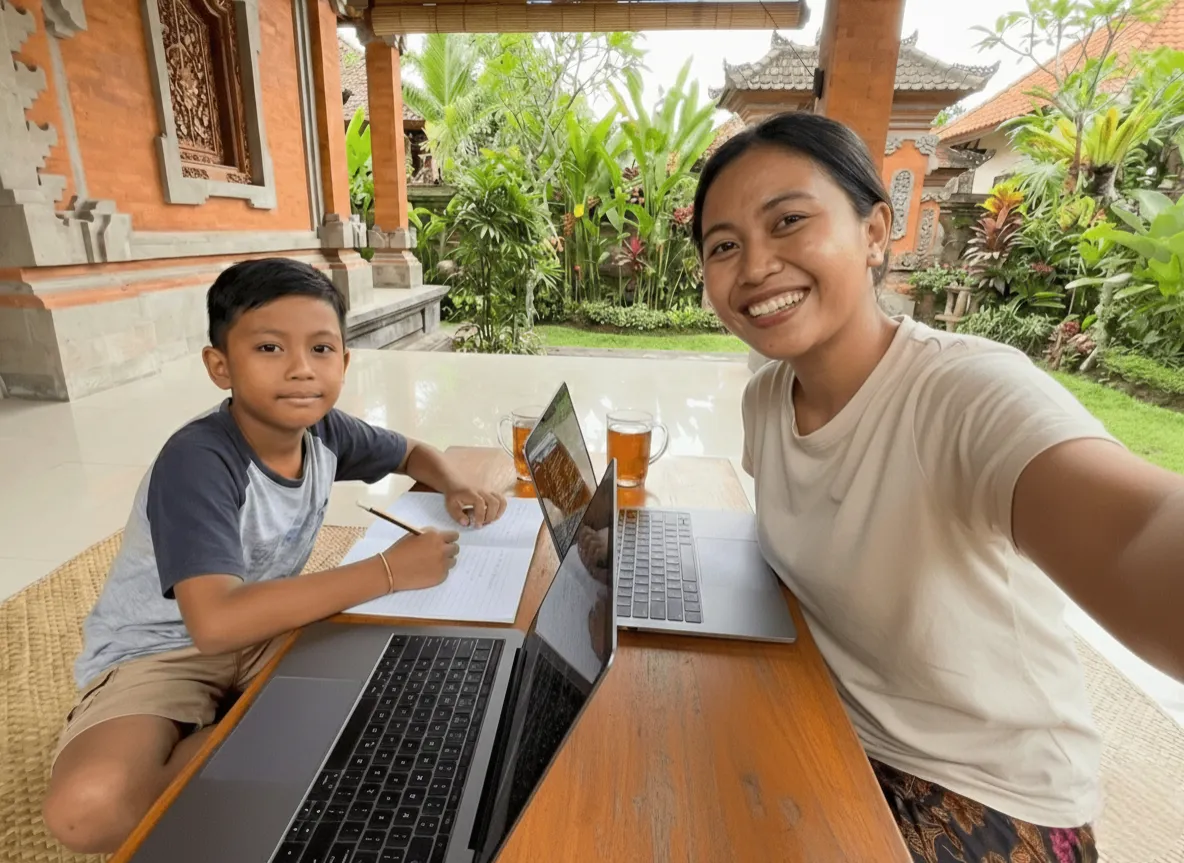
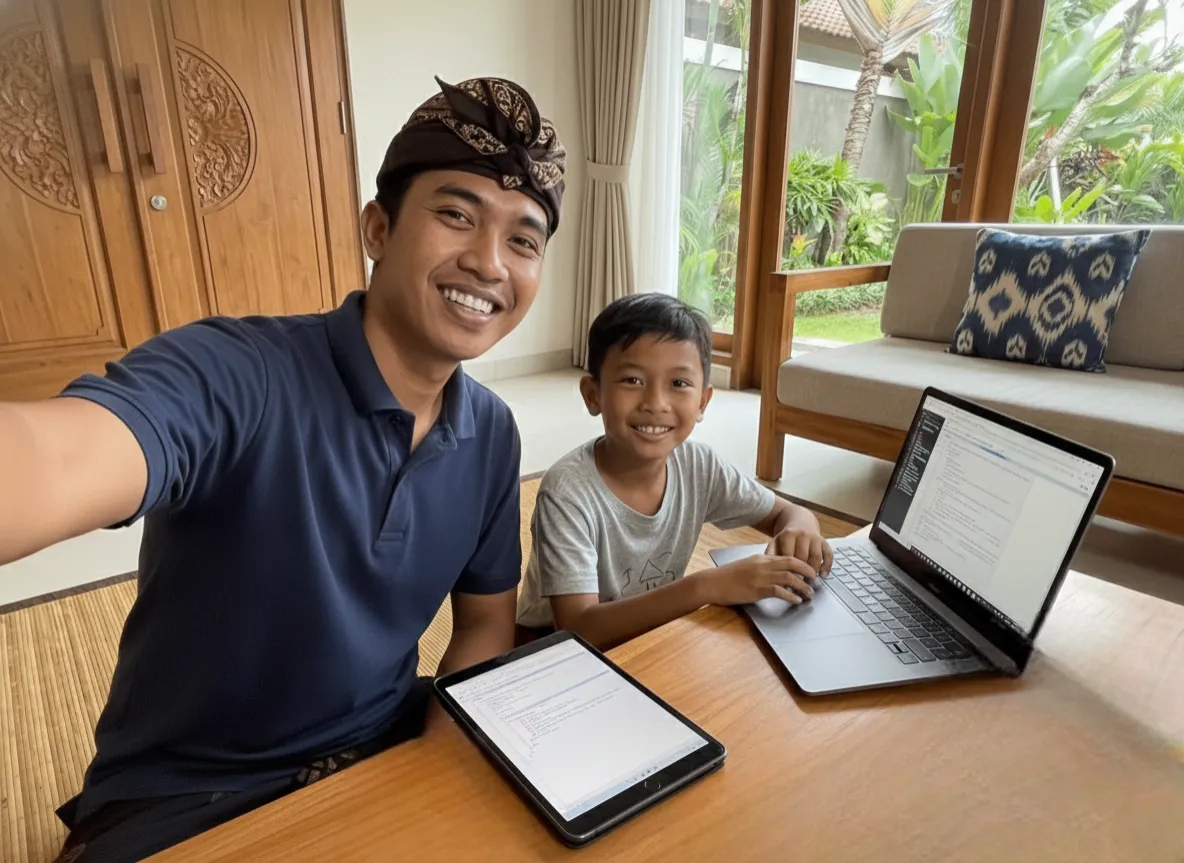
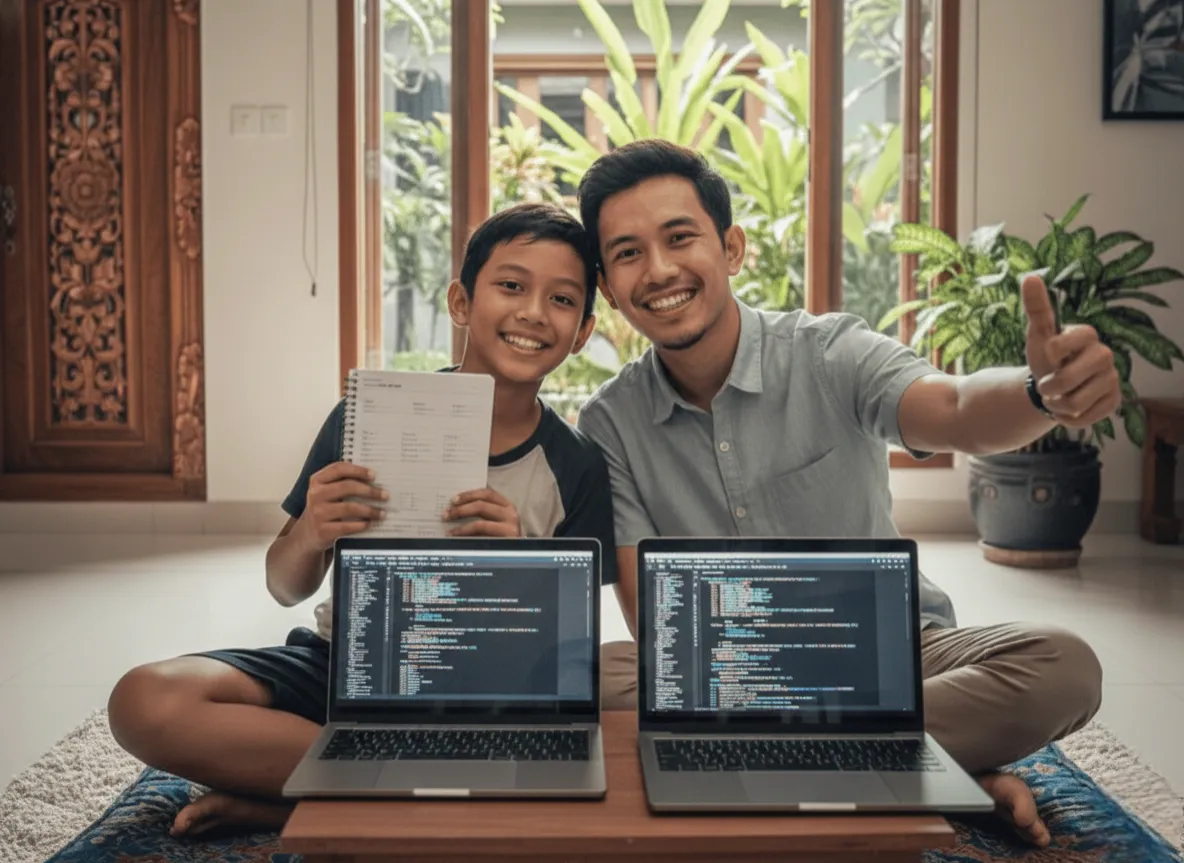
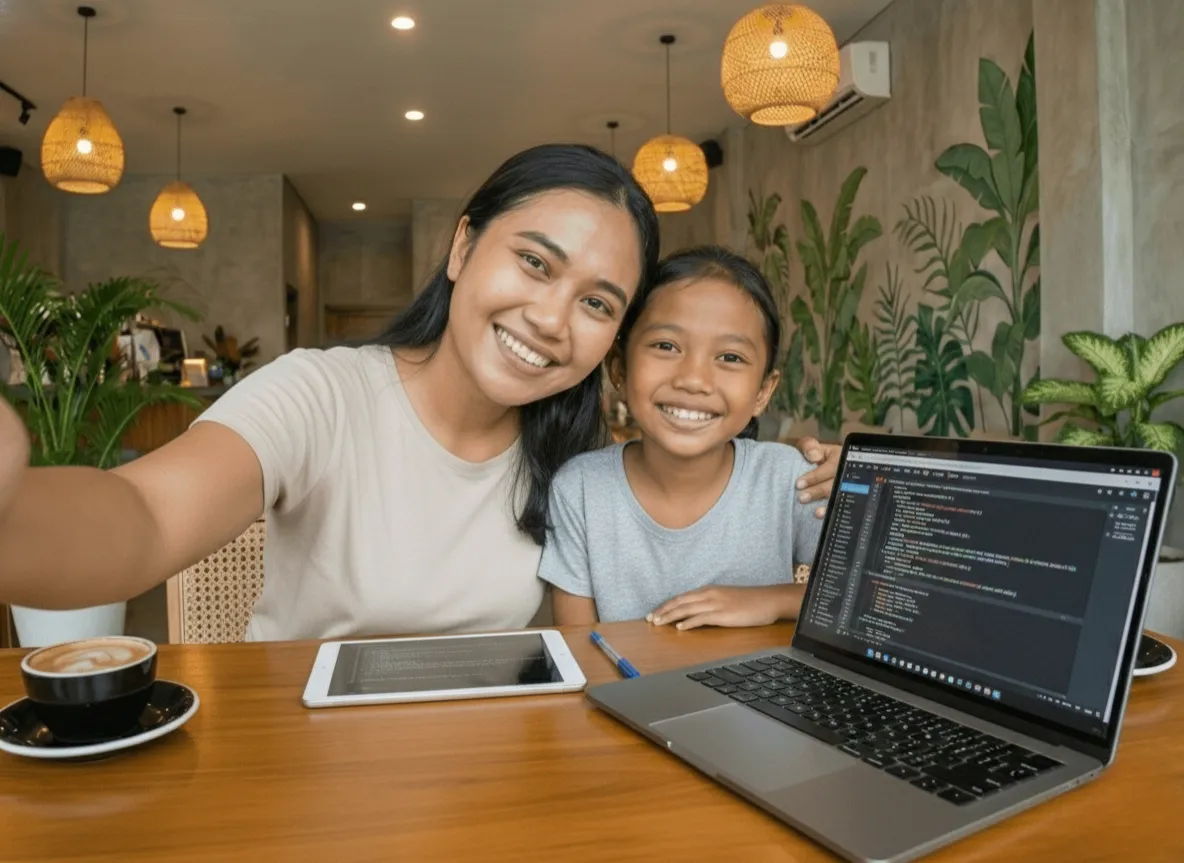
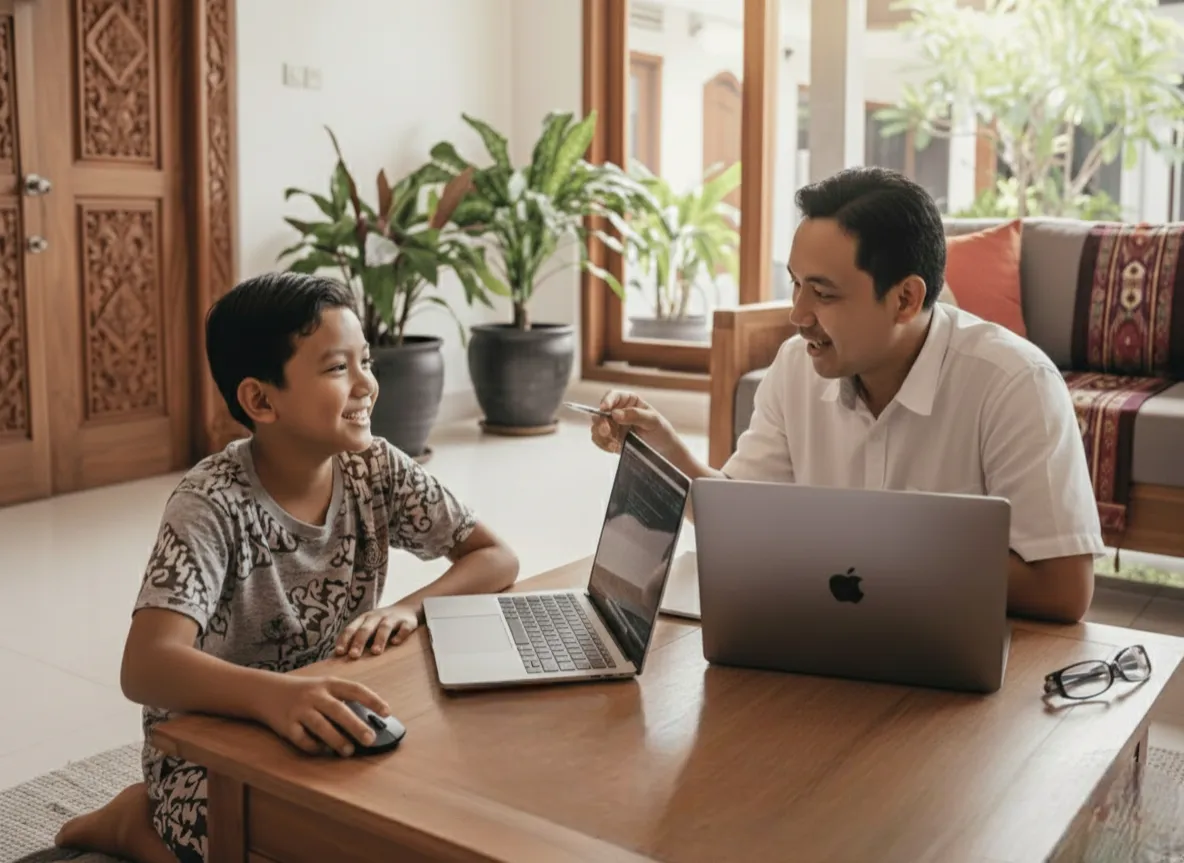
The photographs below were taken during coding lessons for children in Bali sessions with learners on the island.
Online Sessions
Online Sessions in Bali and the Extra Conditions for Children
Online sessions for coding lessons for children in Bali run over Zoom or Google Meet, and for children three conditions decide whether they work. A separate mouse, not a trackpad. An adult within earshot for the first minutes. And a shorter block of real work inside the session, because attention through a screen runs out sooner.
With those in place the subject transfers well, since everything already happens on a screen. The child shares their screen and keeps their own mouse, and the tutor never takes control: a child watching a cursor move learns nothing, and at this age that matters more than finishing the task.
The part that suffers is the showing at the end. A child demonstrating a game to a parent in the room gets a reaction that a shared screen flattens, so tutors ask parents to come and watch for the last two minutes. Fees for online sessions match face-to-face sessions.
Frequently Asked
Questions From Parents About Children's Coding in Bali
What do private coding lessons for children in Bali cost?
Fees start from IDR 174,100 for a 60-minute session, the shortest option. Sessions of 90 and 120 minutes are available with the fee following the length. The final fee follows session length and the number of sessions per month, between 4 and 28. The admin sends the breakdown in writing before the first payment. A computer, a separate mouse, and any account fees are prepared by the learner and not included in the fee.
At what age can a child start coding?
From around 6 in Bali as anywhere, with block coding, where the idea is order: this happens, then this. What decides readiness is reading, not age, because even blocks have words on them. Typed code usually waits until 11 or 12, and the first session finds where a particular child is instead of using their birth date.
My child is fluent in Scratch but stopped at Python. Why?
Because typed code asks for three new things at once: every character correct, nothing running until it is, and error messages written for adults. The crossing is retaken in fragments, with the tutor supplying most of the code and the child typing one line, then two. Keyboard practice runs separately, and going back to blocks for a session is allowed and not treated as failure.
Do coding lessons add to my child's screen time?
Yes, and it is worth saying plainly: the session is an hour in front of a screen. What differs is that the child is producing instead of consuming, the hour has a defined end, and the work gets explained out loud afterwards. Most families count the session inside the week's allowance instead of adding to it, and keep between-session practice to fifteen minutes.
What equipment do we need at home?
A computer the child can use in Bali, a separate mouse, and a chair at the right height. The mouse matters more than parents expect, since dragging blocks on a trackpad is awkward enough to become the obstacle. Accounts for the tools are free at this level, and the tutor helps set them up in the first session.
How is a coding tutor matched to a child?
The schedule is settled first during the consultation, covering days, times, session length, and sessions per month. The Edupola team then looks for a tutor whose travel to your location in Bali stays short, and that search runs 1 to 5 working days. Experience with children of that age is part of the match, and so is patience with the crossing from blocks into typed code. If the first 2 weeks feel like a poor fit, a replacement is arranged at no extra cost.
Related Programmes
Programmes That Usually Follow Coding for Kids in Bali
Families taking coding lessons for children in Bali often add one other programme, usually alongside it.
-
Primary School Tutoring in Bali
Taken when school subjects need support alongside the coding.
-
Programming Tutoring in Bali
Chosen by older children who have crossed into typed code and want to go further.
-

Drawing Tutoring in Bali
Often added by children whose games need their own artwork and animation.
Get Started
Start From the Level That Fits
Tell us your child's age, what they have built before, and the hours they still have energy. A tutor in Bali is matched within 1 to 5 working days.