
Private Robotics Tutoring in Bali
Robotics Tutoring in Bali: Wiring or Code
Robotics tutoring in Bali from Edupola pairs one teacher with one learner at home. A robot that will not move gives the same silence whether the fault is in a wire or in a line of code, so 6 steps of tracing are taught in order. Fees from IDR 197,300 per session.

Rating and fees for robotics tutoring in Bali
| Programme | Robotics Tutoring in Bali |
|---|---|
| Provider | Edupola |
| Description | Private robotics tutoring in Bali, one teacher per learner: a fault in the wiring and a fault in the code look identical, so the order of tracing is what gets taught. |
| Fee | Fees start from Rp197,300 per session. |
| Session Length | Sessions run 60, 90, or 120 minutes. |
| Schedule | Flexible, following the learner's schedule. |
| Start | Lessons can start any time after registration. |
| Sessions per Month | 4 to 20 sessions per month, as needed. |
| Rating | 4.9 out of 5, 116 reviews |
Programme at a Glance
Robotics Tutoring in Bali and Faults That Look Alike
Robotics tutoring in Bali runs one tutor with one learner, at your home. This subject has two layers and they fail in the same way.
A robot that does not move looks the same whether a jumper wire is only touching its socket, a motor is drawing more current than the board can supply, or a line of code names the wrong pin. There is no error message. The program uploads without complaint, the indicator light comes on, and nothing happens.
So what the programme actually teaches is an order of tracing: power first, connections by hand, then each part proved alone before it is put back into the whole. Fees start from IDR 197,300 per 60-minute session, with 4 to 28 sessions a month. This programme holds a 4.9 out of 5 rating across 116 learner reviews in Bali.
Components
Components Used and the Way Each One Fails
Teachers use this with a learner who is stuck. The third column is how that part fails without producing any message at all.
| Component | Its job | How it fails silently |
|---|---|---|
| Breadboard | Connecting components without soldering, so a circuit can be changed quickly | A component leg only touching instead of seated, and the connection drops when the board is nudged |
| Arduino controller board | Running the program and handling the input and output pins | The pin named in the code differs from the pin wired up, and the program runs without complaint |
| Distance and light sensors | Reading the surroundings and sending back a number | Returning a reasonable number outside the range the program assumed, for instance when the room light changes |
| Servo and stepper motors | Moving part of the robot to an angle or by a number of steps | Drawing more current than the board can supply, so the board restarts over and over |
| Power supply and batteries | Supplying voltage to the board and to the motors | Voltage dropping when a motor moves, so the symptom appears only while the robot is running |
| Raspberry Pi | Running heavier programs, including image processing | Its storage card failing quietly, or insufficient power making it slow down without switching off |
Tracing
Six Steps for Tracing a Fault Across Two Layers
This order is the backbone of robotics tutoring in Bali. It is followed in the same sequence every time, including by learners who are sure they know the cause.
-
Check the Power First
Voltage is measured at the actual pin, because a wire that is plugged in does not prove the power arrives. A controller board can light up while a motor rail carries nothing.
-
Check Connections by Hand
Each wire is pulled gently, one at a time. A wire on a breadboard looks seated when its leg is only touching, and that is the single most frequent fault in this subject.
-
Prove Each Part Alone
One sensor is tested with a program a few lines long that does nothing but print its value. A part proved alive on its own stops being a suspect.
-
Print the Value, Do Not Guess
Sensor values are printed to the screen so you can see what the device is reading. Many faults blamed on code turn out to be a sensor returning a number nobody expected.
-
Change One Thing at a Time
Only one thing is changed before testing again. Changing a wire and a line of code together leaves the cause unknown even when the robot starts working.
-
Write Down What Is Proved
Parts already proved alive are written down so they are not checked twice. That note is what keeps a long trace from going in circles.
Learning Path
Robotics Levels From Circuit to Autonomous Robot
The robotics level a learner starts at is set by one simple circuit built in the first session, and never by the kit they own.
-
Level 1
Foundation
Components introduced: small lamps, resistors, and the breadboard; simple circuits; and basic sensors for distance and light. Results are visible immediately, which matters at this level.
- Simple circuits
- Basic sensors
- Visible results
-
Level 2
Intermediate
Arduino programming, further sensors for tilt and rotation, and moving parts: servo motors, stepper motors, and a separate power supply for them.
- Arduino code
- More sensors
- Separate power
-
Level 3
Advanced
A robot that acts on its surroundings: following a line, avoiding obstacles, or running a sequence of tasks. Here the tracing order earns its keep.
- Line following
- Obstacle avoidance
- Task sequences
-
Level 4
Competition Preparation
The build is prepared against the rules of the target contest: size limits, time limits, and how it is scored. What is trained is reliability.
- The real rules
- Repeated testing
- Reliability
Who It Is For
Learners Who Take Robotics Lessons in Bali
Every session holds one learner, so the build and the level are chosen from what that learner wants to make.
-
Pupils Facing a Contest
Learners in Bali preparing a school or regional robotics contest. Sessions are planned backwards from the date, with repeated testing taking the largest share.
-
Children Who Take Things Apart
Learners in Bali whose interest came from dismantling toys and household devices. Sessions start from circuits whose result is immediately visible.
-
Pupils Who Already Code
Learners in Bali who write programs on a screen and want them to move something. The code layer is passed quickly.
-
Students With a Hardware Project
Learners in Bali building an assignment or final project using sensors and a microcontroller. What is taught is how to do it unaided.
-
Learners Building a Useful Device
Learners in Bali who want a device for a real purpose, such as a plant waterer or a temperature monitor. Material is picked for that build.
-
Teachers and Club Coaches
Learners in Bali running a robotics club at their school. The tracing order and how to explain it take the larger share.
One Session
Inside a 60-Minute Robotics Session
This is the division used once a learner has a build in progress. The first and fourth blocks are the ones learners would skip on their own.
-
10 minutes
Checking the State of the Hardware
Power and connections are checked first, including pulling each wire gently. A build that worked last week often does not work today, and this is usually why.
-
10 minutes
One New Component or Command
One component or one command is introduced, then tested on its own with a program a few lines long that only prints its value.
-
20 minutes
Fitted Into the Learner's Build
The new part is fitted into the build in progress. This is where faults usually appear, and tracing them follows the order in the same sequence every time.
-
15 minutes
Testing Repeatedly
The build is run several times in a row, and one success does not count as enough. A robot that worked once has not yet been shown to work.
-
5 minutes
Recording and Setting the Next Step
Parts proved alive are written down, then the teacher sets one thing to do alone together with how to test it.
In a 90 or 120 minute session, a build is assembled and traced in one sitting while the wiring stays as it was checked, which is what learners preparing for a contest usually choose.
Prepared by the Learner
The Equipment That Needs to Be at Home
The admin confirms these once the schedule for robotics tutoring in Bali is agreed. A basic component kit, a laptop, and a simple voltage meter are prepared by the learner and not included in the fee.
-
A Basic Component Kit
One kit containing a controller board, a breadboard, jumper wires, small lamps, resistors, and a few sensors. The teacher names a list to match the learner's level at the consultation.
-
A Laptop With the Software
A laptop for writing and sending programs to the board, plus the upload application. Installing it and the device driver is done with the teacher in the first session, and it genuinely takes that long.
-
A Separate Power Supply
A power supply or batteries for the motors, separate from the controller board's power. A motor drawing from the board makes it restart repeatedly, and the symptom reads as a code fault.
-
A Voltage Meter
A simple meter for checking voltage and continuity. Without one, tracing turns into guessing, because the power layer cannot be inspected by eye.
-
A Permanent Table and Component Trays
A table that is not cleared every day, plus a divided tray for small components. A breadboard circuit breaks when it is moved, and mixed-up small parts cost more time than the build does.
If you have not bought a kit yet, say so during the consultation. The teacher names a list matched to the starting level, so nothing is bought that the first months will not use.
Power
Why Power Is the First Suspect Every Time
One class of fault appears again and again in robotics tutoring in Bali and is almost always mistaken for a coding error: power that is sufficient at rest and insufficient in motion. The controller board lights up, the indicator comes on, the program uploads without complaint, and then the robot stalls the moment a motor is asked to turn.
In Bali, as anywhere, the cause is that a motor draws far more current at the instant it starts moving than it does while turning steadily. If that power is taken from the controller board, the voltage dips briefly, the board drops below its minimum, and it restarts. From outside, what you see is a robot that moves a little and then stops, which looks exactly like a program with a bad loop in it.
So a separate power supply for motors is introduced from the intermediate level, and the power check sits at the first step of the tracing order. The easiest sign to recognise: the fault appears only when the robot moves and never appears when it is tested standing still.
Contests
Reliability Is Scored, and Not Clever Design
For learners in robotics tutoring in Bali heading to a robotics contest, one shift in thinking has to happen early: what is scored is the robot that works on the attempt, and a clever design earns nothing if it fails on the run that counts. Judges across Bali see one attempt, not the idea behind it.
So contest preparation here consists of repeated testing under conditions that resemble the event: a field of the same size, different room lighting, and a battery already half used. Lighting gets particular attention, because light sensors calibrated in one room return different numbers in another, and that single difference has ended more contest runs than any design flaw.
The rules are read together first, since they carry limits that change the design: maximum size, weight, which components are allowed, and how long the build may take. Edupola promises neither a win nor a particular ranking. What is provided is the tracing order, testing under contest-like conditions, and the rules read before the build instead of after it.
What Learners Say
Stories From Robotics Learners in Bali
The quotes below come from learners in Bali who completed the robotics programme at Edupola, with their situation and what changed.
-
★★★★★
Thanks to lessons at Edupola, I could understand Arduino and sensors quickly. The instructor was really patient explaining difficult concepts. The line follower robot I built won 2nd place at the WRO Bali Regional. Now I am preparing for the national level.
2nd place at the WRO Bali Regional, Junior category
Ari B.
Year 9 junior high school student, WRO Bali participant · Verified learner
-
★★★★★
My son used to only like playing games, but after joining robotics lessons at Edupola, he became interested in assembling and programming robots himself. Now he takes components apart and puts them together at home every day. The instructor really understands how to teach children with an enjoyable approach.
The child is more and more eager to learn science and technology
Ayu L.
Mother of a 10-year-old learner · Verified learner
-
★★★★★
I used to know nothing about robotics. After 8 sessions at Edupola, I could already build an obstacle avoidance robot and passed the selection to join the robotics club at school. The learning method is hands-on, so it is never boring at all.
Accepted into the school robotics team after 8 sessions
Arjuna P.
Year 8 junior high school student, Robotics Club member · Verified learner
-
★★★★★
I needed a portfolio of STEM projects to apply to a university in Singapore. The Edupola instructor helped me build a very impressive IoT smart greenhouse monitoring project. My project documentation and presentation skills improved sharply thanks to their guidance.
A robotics portfolio for an application to a university abroad
Dharma W.
Year 11 senior high school student, future engineering student · Verified learner
-
★★★★★
Finding a structured STEM programme for homeschooling is not easy. Edupola provides a step-by-step robotics curriculum that can be adjusted to the learning pace of my two children. They learn while building real projects and can now program Arduino on their own.
A structured STEM curriculum for homeschooling
Suci R.
Homeschooling mother of 2 children · Verified learner
-
★★★★★
I took robotics lessons at Edupola to enrich my STEM teaching methods at school. The instructor is very competent and the material is very applicable for adapting to the classroom. Now I run a robotics extracurricular with confidence.
Integrated robotics into the school curriculum
Adi P.
Junior high school science teacher in Bali · Verified learner
How to Register
Four Steps to the First Robotics Session
The opening consultation carries no fee. The admin asks the learner's age, what they want to build, and what kit exists.
-
Name the Goal and the Kit
The learner's age, what they want to build or which contest they are entering, and the component kit already owned. All three set the starting level.
-
Agree the Schedule
Days, times, session length, and sessions per month are agreed with the admin, following a table where a build can be left standing, since a breadboard circuit breaks when it is packed away between sessions.
-
Matching the Teacher
The team looks for a tutor whose travel to your location in Bali stays short, and that search runs 1 to 5 working days. Contests, hardware projects, and club coaching are matched to teachers who have done them.
-
The First Session
You build one simple circuit while the teacher checks the kit and installs the upload application, then the level is set.
Need help? Contact our admin on WhatsApp for a free consultation.
Documentation
Robotics Lessons With Edupola in Bali
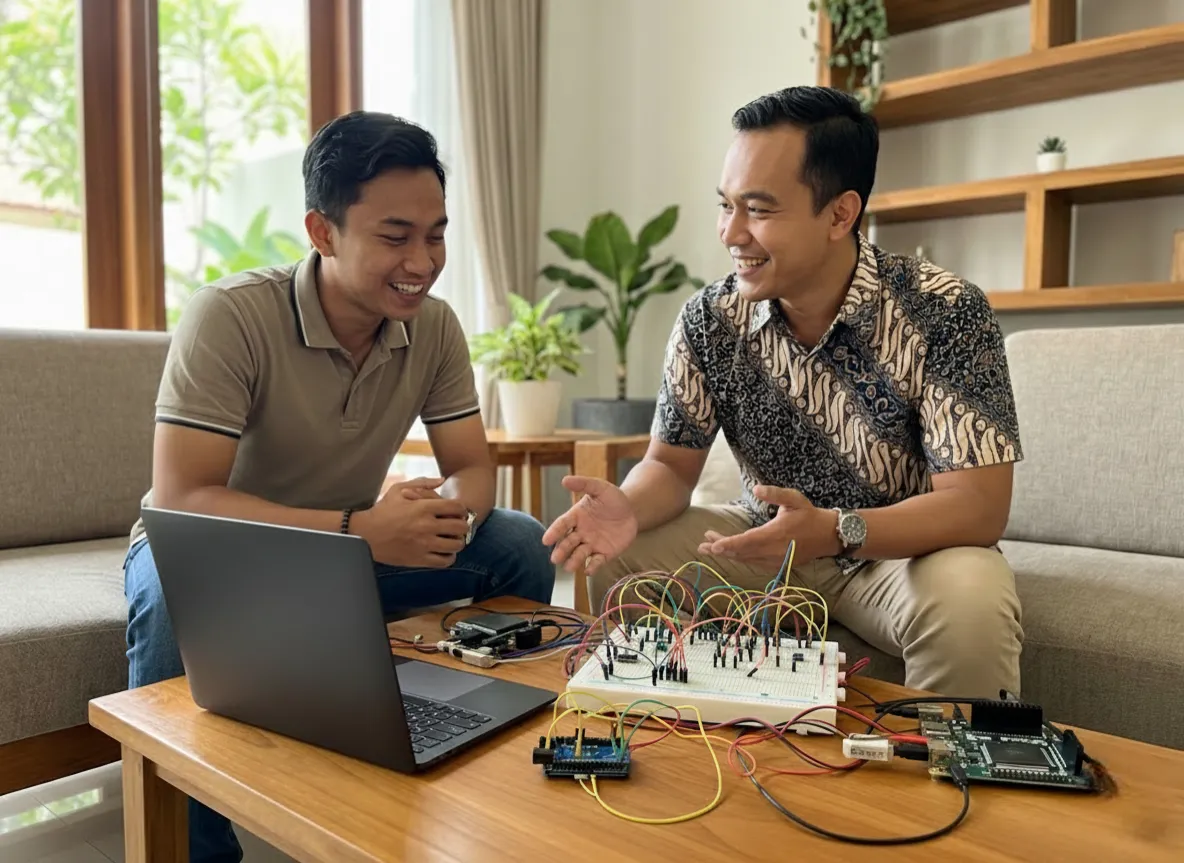
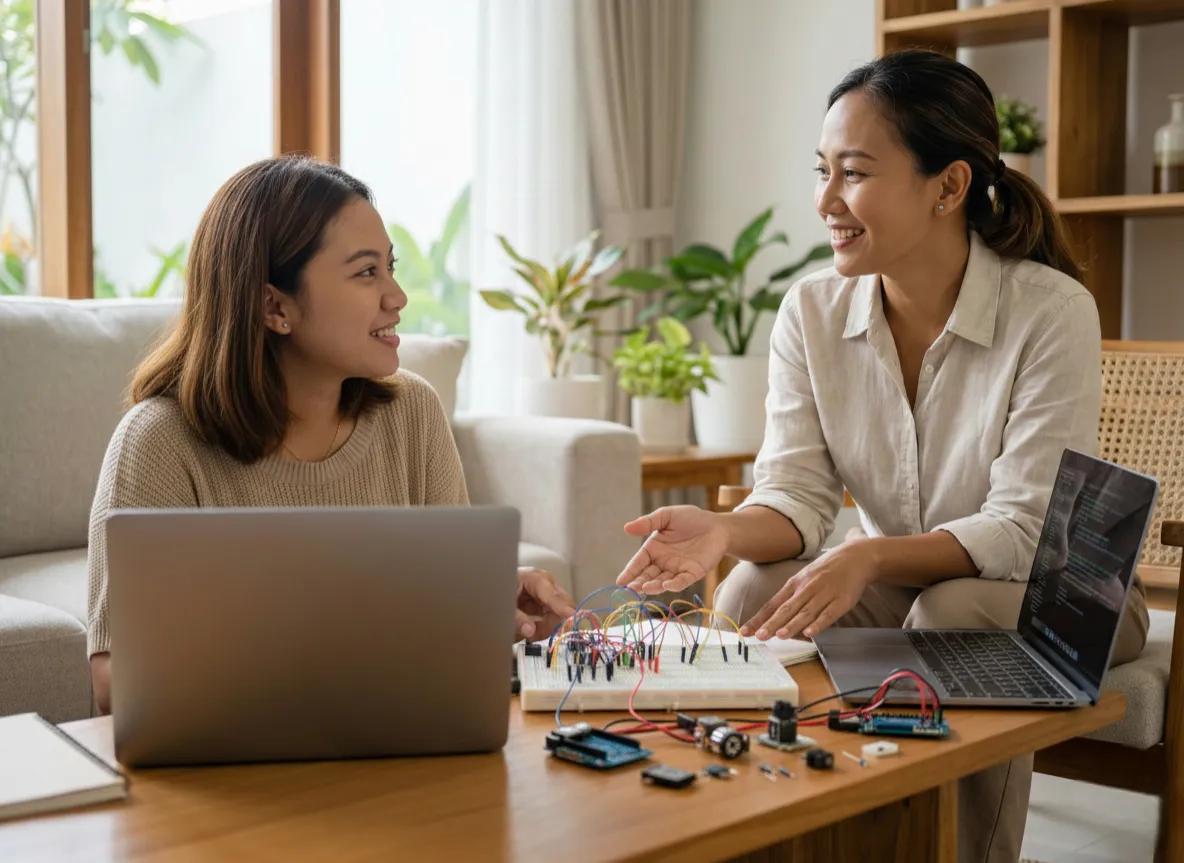
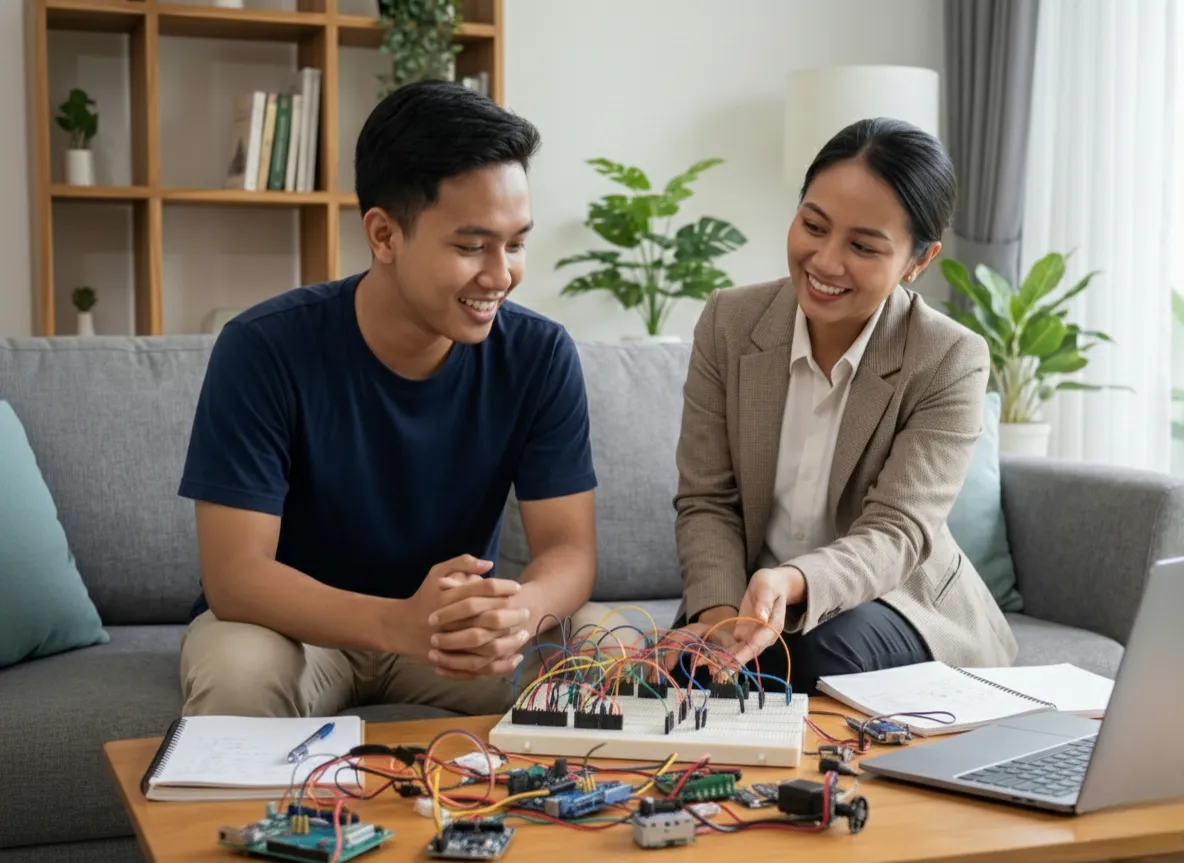
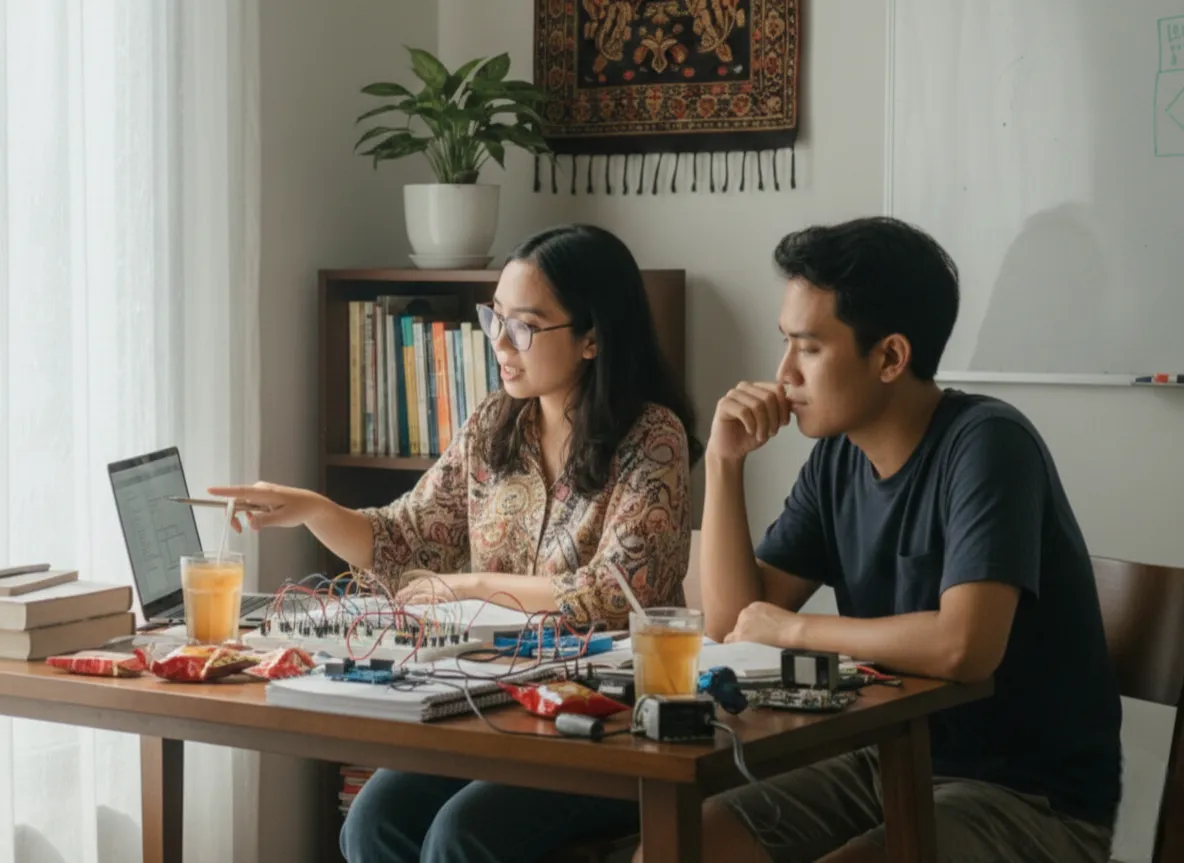
The photographs below were taken during robotics tutoring in Bali sessions with learners on the island.

Service Area
Where Edupola Robotics Teachers Travel in Bali
Tutors for robotics tutoring in Bali travel to the location you choose, from Denpasar, Badung, and Gianyar through to Tabanan, Buleleng, Klungkung, Bangli, Karangasem, and Jembrana. This programme runs at home for one reason particular to it: the build has to stay where it is between sessions.
What needs to exist at the venue is a table that is not cleared every day, a power point, and a divided tray for small components. The admin asks about all three before a teacher is matched, and all three weigh more than the learner's free hours do.
The Edupola office is not used as a lesson venue. Where no tutor is available near you, sessions run online. Part of this programme transfers online and part does not, as the next section explains. Ask the admin about teacher coverage at your location in Bali.
Online Sessions
Online Robotics Sessions and the Layer You Cannot See
Online sessions for robotics tutoring in Bali run over Zoom or Google Meet, and the division follows the two layers of this subject. The code layer moves across easily: the learner shares a screen, the teacher reads the program, and printed sensor values are visible to both at once.
The hardware layer is the one that needs adjusting. A wire whose leg is only touching is invisible to a camera, and pulling each wire gently is something only the learner's own hands can do. So the teacher guides the trace step by step and the learner performs each check, which is slower and also builds the habit faster.
The common arrangement combines both: assembly and hardware tracing taken in person, writing and fixing code taken online. One part is actually better online, namely reading a program together on a shared screen. Fees for online sessions match face-to-face sessions.
Frequently Asked
Questions From Robotics Learners in Bali
What does private robotics tutoring in Bali cost?
Fees start from IDR 197,300 for a 60-minute session, the shortest option. Sessions of 90 and 120 minutes are available with the fee following the length. The final fee follows session length and the number of sessions per month, between 4 and 28. The admin sends the breakdown in writing before the first payment. A basic component kit, a laptop, and a simple voltage meter are prepared by the learner and not included in the fee.
Does a child need to be able to code first?
No. The first level is circuits and basic sensors, where the result is visible without writing much at all, and that is where most children start. Code enters at the intermediate level, in short programs that print a value. Children who already code skip ahead and spend their sessions on the hardware layer instead.
My child's robot does not move even though the code is right. What is usually happening?
Most often the power, and the giveaway is that the fault appears only when a motor is asked to turn. A motor draws far more current at the moment it starts than while it runs, so if it takes that from the controller board the board dips below its minimum and restarts. The second most likely cause is a jumper wire whose leg is only touching its socket.
Which components do I need to buy to start?
A controller board, a breadboard, jumper wires, small lamps, resistors, and a few sensors, plus a laptop and a simple voltage meter. The meter is the item people leave out and the one that turns tracing from guessing into checking. The teacher names a list matched to the starting level, so nothing is bought early that the first months will not use.
Can this programme prepare a robotics contest entry?
Yes, and the preparation is mostly testing instead of building. The rules are read first because they change the design: size, weight, allowed components, and build time. Then the build is tested repeatedly under contest-like conditions, especially different lighting, since light sensors calibrated in one room return different numbers in another.
How is a robotics teacher matched to a learner?
The schedule is settled first during the consultation, covering days, times, session length, and sessions per month. The Edupola team then looks for a tutor whose travel to your location in Bali stays short, and that search runs 1 to 5 working days. The goal matters here: contests, hardware projects, and club coaching are matched to teachers who have done them. If the first 2 weeks feel like a poor fit, a replacement is arranged at no extra cost.
Related Programmes
Other Programmes Learners Add in Bali
Learners taking robotics tutoring in Bali often add one other programme, usually once the code layer starts to limit them.
-

Coding for Kids Tutoring in Bali
Taken by younger learners whose code layer is still a bottleneck, so robotics can concentrate on the hardware.
-

Programming Tutoring in Bali
A choice for learners whose programs are getting long and who want firmer foundations.
-

AI Tutoring in Bali
Often taken by advanced learners whose robot has started processing images or sound.
Get Started
Start Robotics Lessons From the Order of Tracing
Name the learner's age, what they want to build, and what kit is already there. A tutor in Bali is matched within 1 to 5 working days.