
Private Bass Tutoring in Bali
Bass Tutoring in Bali: Heard When It Goes Wrong
Bass tutoring in Bali from Edupola pairs one instructor with one learner at home. The instrument has an unusual job: played well it is felt instead of noticed, and played badly it is the first thing anyone hears. So 6 things get judged, and timing leads all of them. Fees from IDR 120,900 per session.

Rating and fees for bass tutoring in Bali
| Programme | Bass Tutoring in Bali |
|---|---|
| Provider | Edupola |
| Description | Private bass tutoring in Bali, one instructor per learner: timing and root notes first, then groove and space, walking lines, and slap technique with recording. |
| Fee | Fees start from Rp120,900 per session. |
| Session Length | Sessions run 60, 90, or 120 minutes. |
| Schedule | Flexible, following the learner's schedule. |
| Start | Lessons can start any time after registration. |
| Sessions per Month | 4 to 20 sessions per month, as needed. |
| Rating | 4.9 out of 5, based on 107 reviews |
Programme at a Glance
Bass Tutoring in Bali and the Instrument's Actual Job
Bass tutoring in Bali runs one tutor with one learner, at your home, on your own bass. The instrument is judged differently from every other one in a band, and learners who miss that practise the wrong things for years.
A bass played well is not noticed. The song feels solid, the drums sound tighter than they are, and nobody compliments the bass. A bass played badly is the first thing everyone hears, even listeners who could not name the instrument: the song feels loose, or rushed, or oddly empty.
That asymmetry decides the order here. Timing comes before everything, then note length, then the connection with the drummer, then harmony and movement. Slap and the showy techniques come last, because they are the least of the job. Fees start from IDR 120,900 per 60-minute session, with 4 to 28 sessions a month. This programme holds a 4.9 out of 5 rating across 107 learner reviews in Bali.
What Is Judged
Six Things Judged in a Bass Performance
These are what an instructor in bass tutoring in Bali listens for, in this order. The last two are the ones self-taught players usually practise first.
-
Where the Note Lands
Slightly early, slightly late, or on the beat. This is the whole job, and it is why the metronome is never put away in this programme.
-
How Long the Note Is Held
Note length decides whether a song feels tight or muddy, and most beginners hold everything too long. Releasing deliberately is a trained skill.
-
The Connection With the Drummer
Locking to the kick and leaving the snare alone, which is a listening skill more than a playing one. It is what makes two people sound like one instrument.
-
Root Notes and Their Movement
Knowing which note supports the chord and how to move between them. A wrong root is the one bass mistake that even non-musicians hear immediately.
-
Even Plucking Strength
Every note at a consistent volume, so the line sits steady under the song. Uneven attack reads as nervousness through a speaker.
-
Clean Sound From the Left Hand
No buzz, no ringing strings left sounding. Dull mechanical work, and the difference between a recording that can be used and one that cannot.
Goal Map
Learner Goals and Where the Practice Goes
Bass instructors use this to divide the sessions. The third column is the thing that most often trips a learner with that goal.
| Goal | What comes first | The usual stumbling point |
|---|---|---|
| Playing in a worship team | Chord charts and following a leader's changes | Transposing on the spot when the key is changed |
| Playing in your own band | Groove, note length, and locking to the kick | Playing too many notes, which crowds the singer |
| Backing band and function work | Repertoire breadth and reading a chart quickly | Songs in unfamiliar keys with no time to prepare |
| Jazz and funk | Walking lines and the harmony under them | Slap practised before timing is reliable |
| Music degree study | Theory, reading, and examination repertoire | Reading notation at tempo instead of by memory |
| Self-taught player upgrading | Fixing timing and hand position first | Years of habit, which take weeks to loosen |
Learning Path
The Order of Material From Timing to Slap
The bass level a learner starts at is set by what a metronome reveals, and never by how many songs they can play along to.
-
Stage 1
Timing and Root Notes
One note, played in time, repeatedly, with a metronome. The least glamorous stage in the programme and the one that decides whether a learner is useful in a band.
- Metronome from day one
- Root notes
- Note length
-
Stage 2
Groove and Space
Patterns, and the decision not to fill every gap. Learners discover that removing notes makes a line feel better, which is counterintuitive until they hear it.
- Patterns
- Leaving space
- Locking to the kick
-
Stage 3
Walking Lines and Movement
Moving between chords with purpose instead of staying on the root. The harmony behind it is taught at the same time, because the notes only make sense with it.
- Walking lines
- Harmony behind them
- Chord charts
-
Stage 4
Slap Technique and Recording
Thumb, pop, and the techniques learners usually want first, plus recording where consistency is exposed. Last in the order on purpose.
- Thumb and pop
- Harmonics and tapping
- Recording
Who It Is For
Learners Who Take Bass Lessons in Bali
Every session holds one learner, so the songs worked on are the ones that learner actually plays.
-
Worship Team Players
Learners in Bali playing weekly in a service here. Chord charts and transposing on the spot are the practical skills, since keys change without notice.
-
Members of Their Own Band
Learners in Bali writing with a group. Groove and restraint carry the sessions, because the common fault is playing over the singer.
-
Function and Backing Players
Learners playing at hotels and events in Bali. Repertoire breadth and reading a chart fast matter more than technical ceiling.
-
Jazz and Funk Listeners
Learners who want walking lines and slap. Timing is secured first, which they find frustrating and which makes the slap work land.
-
Music Students
Learners in Bali with examination repertoire and theory. Reading at tempo is usually the gap, since most arrive playing by memory.
-
Self-Taught Players
Learners in Bali who have played for years alone. The first session with a metronome is uncomfortable and tells them exactly where they are.
One Session
Inside a 60-Minute Bass Session
This is the division used once a learner has songs to bring. The recording near the end is where timing stops being a matter of opinion.
-
10 minutes
Warm-Up in Time
Hands warmed with a metronome running, so timing is present from the first note instead of added later in the hour.
-
15 minutes
One New Pattern
A single groove or movement, slowly, until it runs without thought. One per session, since bass patterns blur together when stacked.
-
20 minutes
The Learner's Own Song
The pattern applied to a song they will play this week, in the key they will play it in instead of the key of the recording.
-
10 minutes
Recording One Section
A short section recorded and played back. Timing sounds fine while playing and is unambiguous on a recording, which is the point.
-
5 minutes
Setting the Daily Practice
What to practise, at what tempo, for how long, written down so the week has a plan instead of a vague intention.
In a 90 or 120 minute session, a whole song is prepared and recorded from end to end, which is what learners with a performance or a recording coming up usually choose.
Prepared by the Learner
What to Have Ready Before the First Session
The admin confirms these once the schedule for bass tutoring in Bali is agreed. A bass, an amplifier, strings, and a cable are prepared by the learner and not included in the fee.
-
Your Own Bass Guitar
Whatever you own, four strings or five. Practice between sessions is what moves a bass player forward, so an instrument at home decides progress more than lesson frequency does.
-
An Amplifier or Small Speaker
Something to hear the instrument through. An unamplified electric bass is almost inaudible, so a learner cannot hear their own note length, which is half the job.
-
Strings That Are Still Alive
Dead strings sound dull and make tone impossible to judge. A fresh set is cheap and changes the first session noticeably more than learners expect.
-
A List of Songs You Play
The songs you actually perform or rehearse, with their keys if you know them. They become the material, which is why progress feels immediately usable.
-
A Metronome on Your Phone
Any free application. It is used in every session and in every practice, and a learner without one practises timing that only works alone.
If you have no amplifier, say so during the consultation. The instructor advises on the smallest thing that will do the job, since a large amplifier is rarely the right first purchase.
The Metronome
The Metronome Is Never Put Away in This Programme
Most instruments use a metronome while learning and drop it afterwards, in Bali and everywhere else. In bass tutoring in Bali it stays, through every stage, including the advanced ones, and learners who have played for years are the most surprised by this.
The reason is the job. A bass player who drifts by a fraction of a beat makes a whole band sound unsteady, and nobody in the room can say why. Worse, the drift is inaudible to the player: you hear yourself relative to your own internal pulse, and that pulse is what moved. Only an external reference exposes it, which is why recording and the metronome do the teaching that ears alone cannot.
In practice it is less tedious than it sounds. Patterns are learned slower than the song and brought up in steps, and a learner can hear the improvement in their own recordings within a few weeks. The usual discovery is specific and humbling: the timing was fine on the first bars and slid on the repeats, which is exactly what listeners register as a song losing energy.
What Learners Say
Stories From Bass Learners in Bali
The quotes below come from learners in Bali who completed the bass programme at Edupola, with their situation and what changed.
-
★★★★★
I could only pluck roughly at first. After 10 sessions at Edupola I can play walking bass and follow a chord chart.
Trusted with bass in the weekly worship team
Dharma P.
Church band bassist · Verified learner
-
★★★★★
I joined a band knowing almost nothing about bass. Lessons at Edupola taught me groove and how to sit in the pocket.
The band released a single with an original bassline
Ratna S.
Indie band member · Verified learner
-
★★★★★
I had wanted to slap like the players I admire for years. My Edupola instructor broke the technique down step by step from the thumb.
Can play slap and join jazz jam sessions
Agus W.
Jazz and funk listener · Verified learner
-
★★★★★
I play bass in a hotel cover band and my technique was messy. After studying at Edupola my tone and timing are far better.
Live performance quality improved sharply
Eka M.
Cover band player · Verified learner
-
★★★★★
I needed an extra tutor because the campus bass material is demanding. My Edupola instructor helped me understand the theory behind it.
Passed the practical bass examination with top marks
Ayu L.
Music undergraduate · Verified learner
-
★★★★★
I had played bass for 3 years alone and was stuck with the same few techniques. At Edupola I learned tapping, harmonics, and more.
Recorded bass for a local album
Setiawan
Self-taught bassist upgrading · Verified learner
Restraint
A Line That Supports Beats a Line That Is Busy
The most common correction in bass tutoring in Bali is to play less. Learners arrive wanting to be heard, which is understandable and works against the instrument: a busy bass line competes with the singer, crowds the drums, and makes a song feel smaller instead of bigger.
What supports a song is usually simpler than learners expect. The right note, at the right moment, held for the right length, with gaps left where the drums or the voice need room. Gaps feel like laziness to a new player and read as confidence to a listener, and hearing that difference is a trained skill.
Instructors teach it by subtraction, in the learner's own song. The line is played as written, then with half the notes removed, then recorded both ways and compared. Almost every learner prefers the simpler version once they hear it from outside, and that moment does more than any amount of explanation.
How to Register
Four Steps to the First Bass Session
The opening consultation carries no fee. The admin asks what bass you have and where you play.
-
Name the Instrument and Where You Play
Your bass, and whether you play in a band, a service, at events, or alone. Those two answers set the order of the material.
-
Agree the Schedule
Days, times, session length, and sessions per month are agreed with the admin, following the minutes you can give to daily practice with a metronome.
-
Matching the Instructor
The team looks for a tutor whose travel to your location in Bali stays short, and that search runs 1 to 5 working days. Worship, function work, and jazz are matched to instructors who play them.
-
The First Session
You play with a metronome running, your hand position is checked, and the starting stage is set from what the timing shows.
Need help? Contact our admin on WhatsApp for a free consultation.
Documentation
Bass Lessons With Edupola in Bali
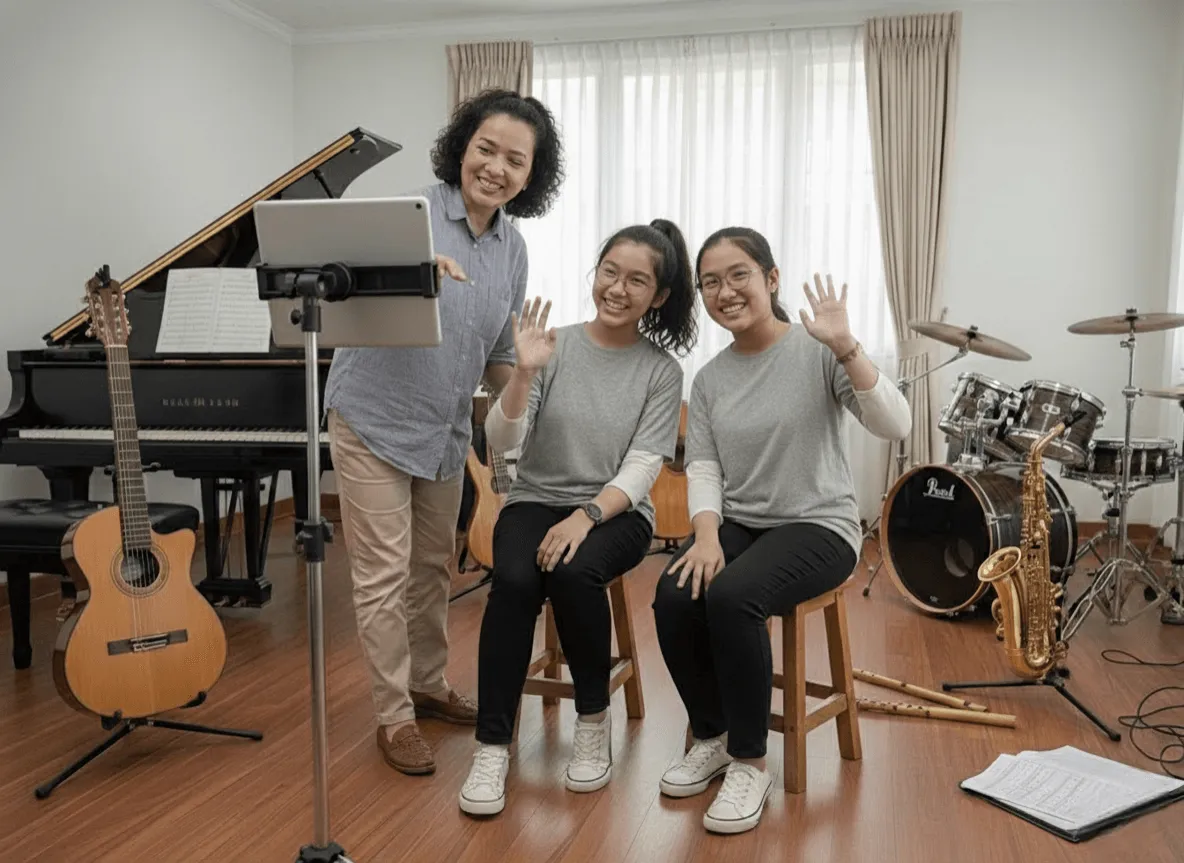
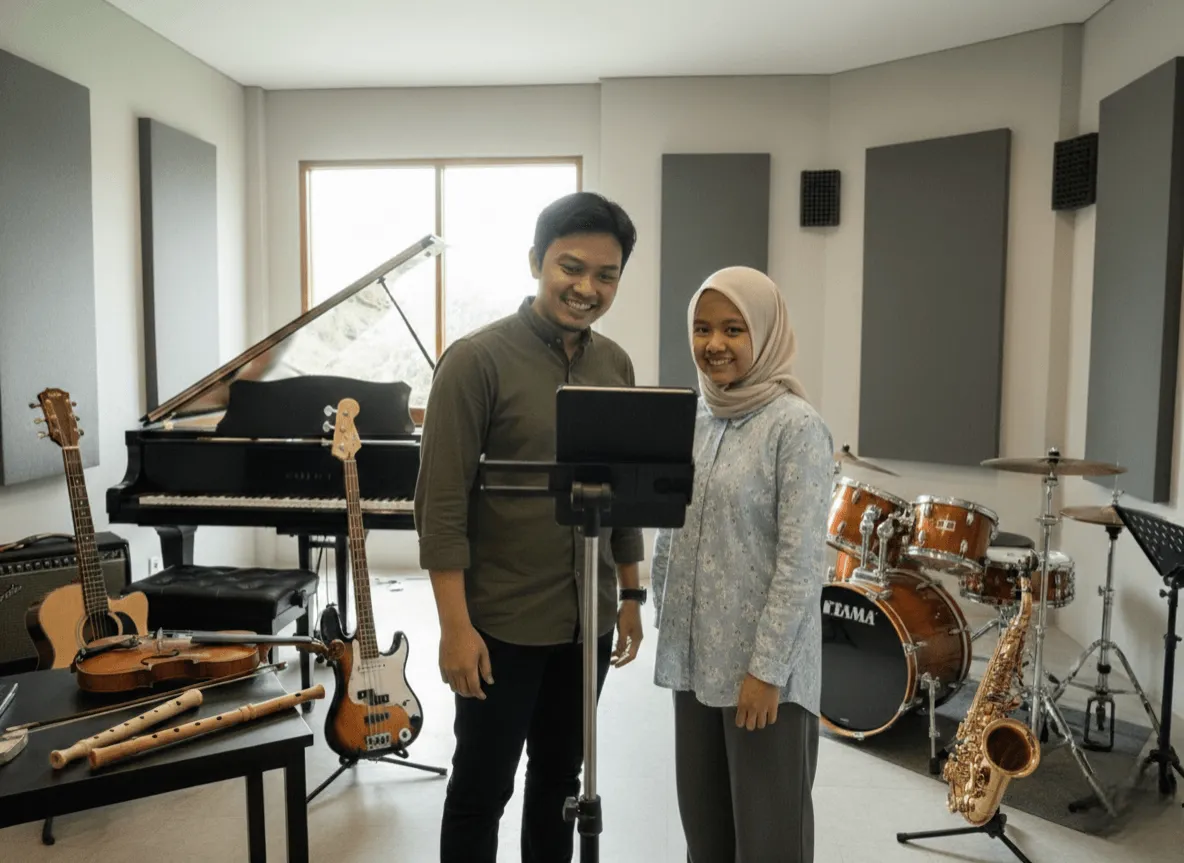
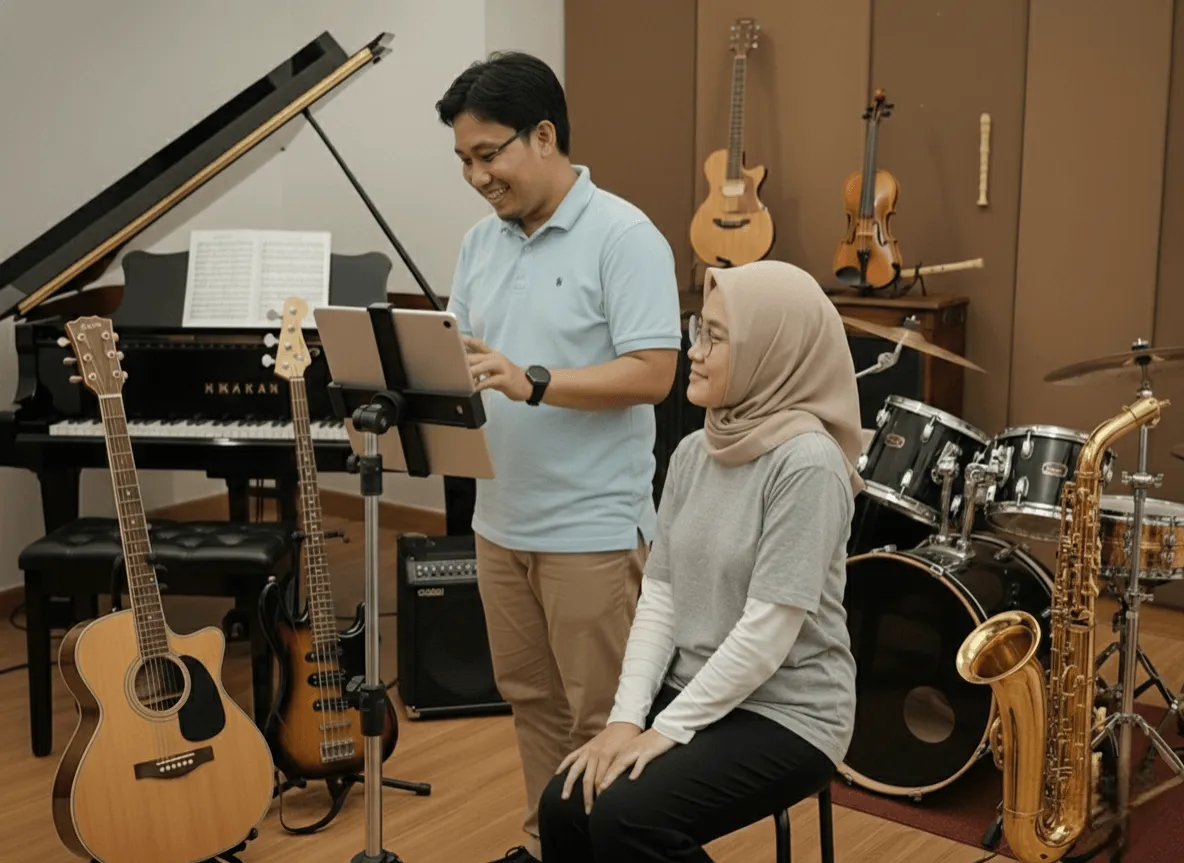
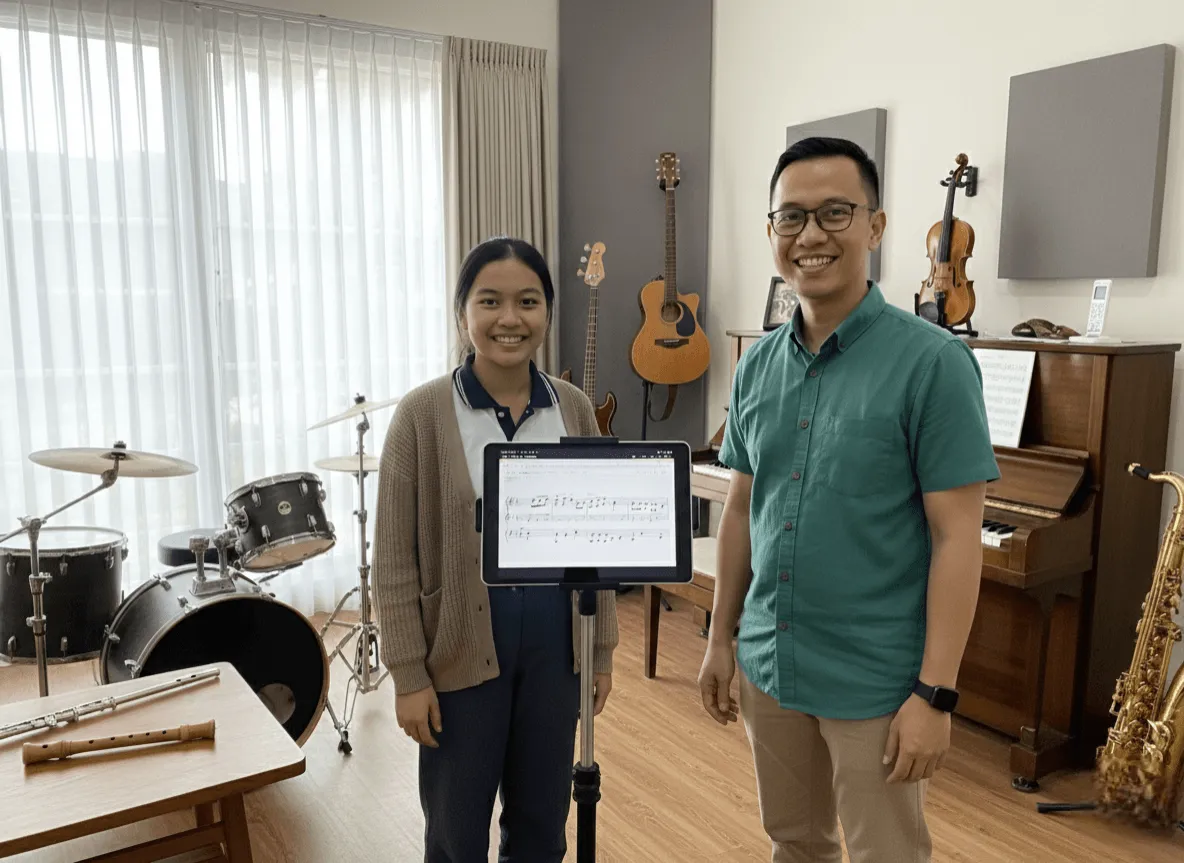
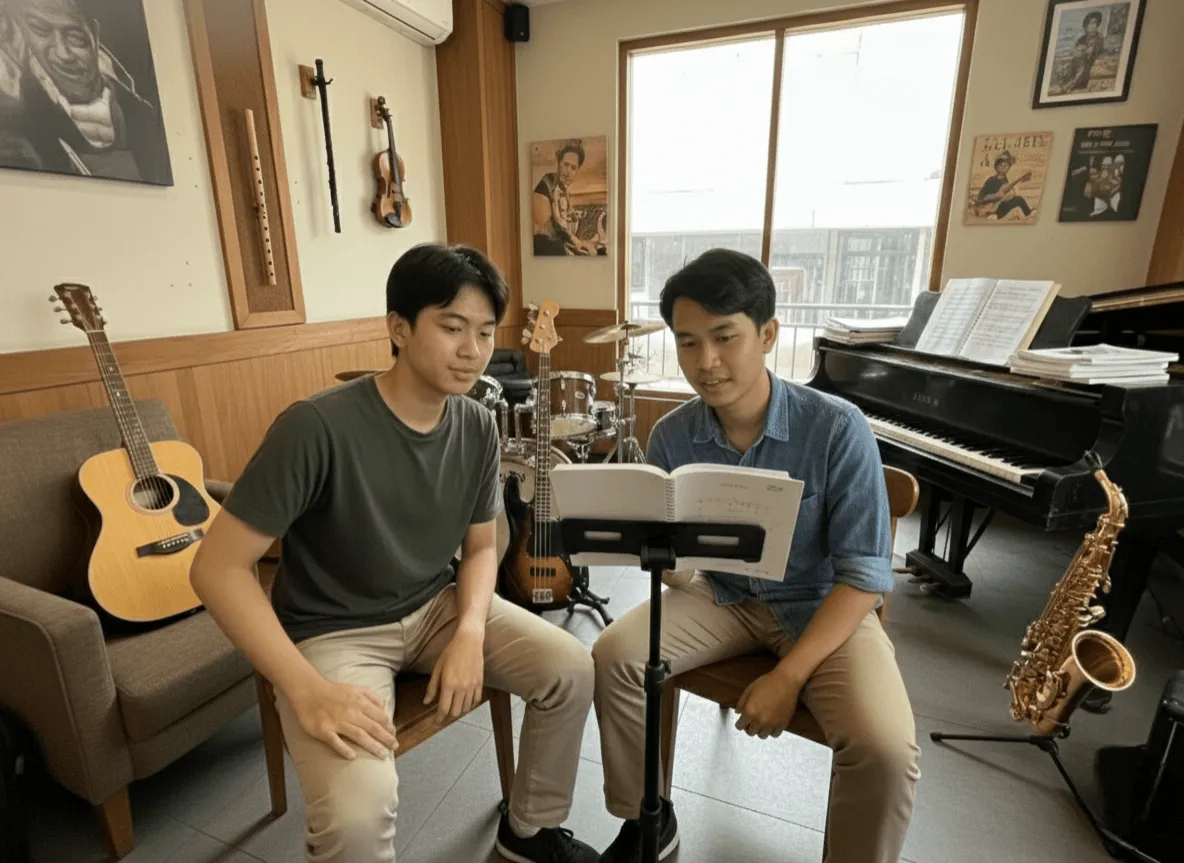
The photographs below were taken during bass tutoring in Bali sessions with learners on the island.
Service Area
Where Edupola Bass Instructors Travel in Bali
Tutors for bass tutoring in Bali travel to the location you choose, from Denpasar, Badung, and Gianyar through to Tabanan, Buleleng, Klungkung, Bangli, Karangasem, and Jembrana. The session happens where the bass and the amplifier are, and the room needs enough tolerance for low frequencies, which travel through walls more than learners expect.
The match turns on the setting a learner plays in. Worship, function and hotel work, band playing, and jazz each ask for different habits, and an instructor who works in one is not automatically right for another. Learners preparing a recording are matched where possible with instructors who have recorded.
The Edupola office is not used as a lesson venue. Where no tutor is available near you, sessions run online. Online bass sessions have one genuine limitation worth knowing, described next. Ask the admin about instructor coverage at your location in Bali.
Online Sessions
Online Sessions in Bali and the Limit on Playing Together
Online sessions for bass tutoring in Bali run over Zoom or Google Meet, and most of a bass lesson transfers: hand position, patterns, harmony, chord charts, note length, and reviewing a learner's recordings.
Playing together does not, and the reason is unavoidable. Every connection adds a delay, and bass is the instrument where a fraction of a beat matters most, so the instructor and learner cannot lock to each other live. The workaround is a shared metronome click and the learner recording their part to be reviewed, which is how session players work anyway.
That constraint makes the online route unusually honest for this instrument. A learner who records their part and hears it against a click learns more about their own timing than one who plays alongside a teacher and feels supported. Fees for online sessions match face-to-face sessions.
Frequently Asked
Questions From Bass Learners
What does private bass tutoring in Bali cost?
Fees start from IDR 120,900 for a 60-minute session, the shortest option. Sessions of 90 and 120 minutes are available with the fee following the length. The final fee follows session length and the number of sessions per month, between 4 and 28. The admin sends the breakdown in writing before the first payment. A bass, an amplifier, strings, and a cable are prepared by the learner and not included in the fee.
I already play from teaching myself. What would lessons add?
Usually timing and note length, which are the two things that cannot be self-assessed. A player hears themselves against their own internal pulse, so drift is inaudible from the inside. The first session plays with a metronome running and the result is uncomfortable and useful: for most self-taught players the timing is fine at the start of a line and slides on the repeats.
Do I need my own bass?
Yes, something to practise on at home in Bali. Lessons are weekly and practice is daily, and bass is an instrument where the hands need frequency more than duration. Four strings or five both work. If you are buying, the instructor advises on what to look for at your budget, since the common first-purchase mistake is a neck too wide for the player's hand.
Do I need an amplifier at home?
Something to hear the instrument through, yes, and it does not need to be large. An unamplified electric bass is almost inaudible, which means a learner cannot hear their own note length or whether strings are ringing on. A small practice amplifier or an audio interface with headphones both solve it, and headphones have the advantage of not disturbing anyone.
When is slap technique taught?
Late, and that ordering is deliberate instead of gatekeeping. Slap is the technique most learners ask for first and the least important part of the job; built on unreliable timing it sounds worse than simple playing. Once timing, note length, and locking to the drums are secure, slap takes a few sessions instead of months, because the hand is already disciplined.
How is a bass instructor matched to a learner?
The schedule is settled first during the consultation, covering days, times, session length, and sessions per month. The Edupola team then looks for a tutor whose travel to your location in Bali stays short, and that search runs 1 to 5 working days. The setting matters here: worship, function work, band playing, and jazz are matched to instructors who play in them. If the first 2 weeks feel like a poor fit, a replacement is arranged at no extra cost.
Related Programmes
Rhythm and Voice Programmes Taken Alongside Bass in Bali
Learners taking bass tutoring in Bali often add one other programme, usually because the bass only makes sense alongside other players.
-

Drum Tutoring in Bali
Taken by learners who want to understand the part they lock to.
-

Guitar Tutoring in Bali
Chosen by learners who want to write songs as well as hold a part.
-

Vocal Tutoring in Bali
Often added by learners who sing while playing in a band.
Get Started
Start From the Song You Are Playing This Week
Name your bass, where you play, and the songs you have to be ready for. A tutor in Bali is matched within 1 to 5 working days.