
Private Music Tutoring in Bali
Music Tutoring in Bali: The Songs Choose the Instrument
Music tutoring in Bali from Edupola pairs one tutor with one learner at home. Almost everyone asks which instrument is easiest, and that is the wrong question. Bring 3 songs you want to play and the instrument chooses itself. Fees from IDR 120,900 per 60-minute session.
Rating and fees for music tutoring in Bali
| Programme | Music Tutoring in Bali |
|---|---|
| Provider | Edupola |
| Description | Private music tutoring in Bali, one tutor per learner: the instrument is chosen from the songs you want to play, then beat, notation, ear, and playing with other people. |
| Fee | From Rp120,900 per session |
| Session Length | 60, 90, or 120 minutes per session |
| Schedule | Flexible, by agreement |
| Rating | 4.8 out of 5, based on 159 reviews |
Programme at a Glance
Music Tutoring in Bali and Your First Decision
Music tutoring in Bali runs one tutor with one learner, at your home. One decision comes before everything, and most learners ask about it the wrong way round.
The question arrives as which instrument is easiest. It is the wrong question because every instrument is easy for a week and hard by the second month, and because the thing that keeps a learner playing is not ease. It is wanting to play the specific music in their head.
So the first session starts from songs: two or three pieces the learner actually wants to play, and the instrument follows from them. After that, everything underneath is shared regardless of instrument, which is why this programme exists separately from the single-instrument ones. Fees start from IDR 120,900 per 60-minute session, with 4 to 28 sessions a month. This programme holds a 4.8 out of 5 rating across 159 learner reviews in Bali.
Instruments
Instruments Available and What to Know First
Music tutors use this with a learner choosing. The third column is the thing people fail to anticipate, and it is the most common reason an instrument gets abandoned.
| Instrument | Fastest satisfaction comes from | What people rarely anticipate |
|---|---|---|
| Guitar | Accompanying a song with four chords | Chord changes stall almost everyone for a few weeks |
| Piano or keyboard | Reading and playing a melody early | Hands doing different things takes longer than expected |
| Vocal | No instrument to buy, and daily use | The voice depends on sleep and health, so progress is uneven |
| Drums | Groove within the first sessions | Volume; most homes in Bali need a practice pad or an electronic kit |
| Violin | Expressive tone once intonation settles | There are no frets, so early sound is rough for months |
| Bass | Locking into a song with a band quickly | It is least rewarding alone and most rewarding with other players |
Learning Path
The Order of Material in Music Lessons
The music level a learner starts at is set by what they can already play, and never by how long they have owned the instrument.
-
Stage 1
One Song You Can Finish
A complete piece, simplified as far as needed, played start to finish within the first weeks. Finishing something is what converts curiosity into practice.
- One complete piece
- Simplified as needed
- Finished early
-
Stage 2
Beat and Reading
Playing in time and reading enough notation to learn without a video. The least exciting stage and the one that makes a learner independent.
- Metronome work
- Basic notation
- Counting bars
-
Stage 3
Playing With Other People
Keeping time with someone else, listening while playing, and leaving space. Most learners discover their timing was weaker than they thought here.
- Timing with others
- Listening while playing
- Leaving space
-
Stage 4
A Chosen Style and a Small Performance
Genre-specific technique and a short performance for family, an event, or a recording. The deadline is the point, since it concentrates months of practice.
- Genre technique
- A real deadline
- Performing or recording
Who It Is For
Learners Who Take Music Lessons in Bali
Every session holds one learner, so the instrument and the songs are chosen with that learner.
-
Children Starting Out
Learners in Bali beginning young here on the island. Instrument size and the noise it makes at home are checked before anything, because both decide whether practice happens.
-
Parents Supporting a Child
Learners in Bali who want enough music to help with practice. A few months is usually enough to read what the child is set and keep them honest about the beat.
-
Adults Who Postponed It
Learners who always meant to play. Adults practise deliberately and read slower than children, and a first song is reachable within weeks.
-
Players at Events
Learners in Bali who perform at ceremonies and functions across the island. Repertoire breadth and playing with other people carry the sessions.
-
Learners Changing Instrument
Learners in Bali who already play something. The shared foundation transfers entirely, so the new instrument moves far faster than the first one did.
-
Graded Examination Candidates
Learners working to a syllabus. Pieces, scales, sight reading, and aural work are all planned back from the month of the examination.
One Session
Inside a 60-Minute Music Session
This is the division used once an instrument is chosen. The playing-together block is the one learners most often want to skip and benefit from most.
-
10 minutes
Instrument Warm-Up
Whatever the instrument needs: fingers, breath, or wrists. Cold hands produce tension that becomes technique if it is repeated weekly.
-
20 minutes
The Piece in Progress
The current song in sections, not from the top. Starting from the beginning every session polishes the opening and abandons the middle.
-
10 minutes
Reading New Material
Something never seen before, read slowly. Short and weekly is what builds reading; a long occasional session does not.
-
15 minutes
Playing Together
The tutor plays along, which exposes timing the learner cannot hear alone. Uncomfortable at first and the fastest route to playing with other people.
-
5 minutes
Setting the Daily Practice
The week gets a plan: what to practise, how slowly, and for how long, written in the learner's own book.
In a 90 or 120 minute session, two pieces are worked through and then played as a short set, which is what learners preparing for a performance or an examination usually choose.
Prepared by the Learner
What to Have Ready Before the First Session
The admin confirms these once the schedule for music tutoring in Bali is agreed. An instrument, a metronome application, and sheet music are the learner's responsibility and not included in the fee.
-
Two or Three Songs You Are Aiming At
Specific pieces, however ambitious. They are how the instrument gets chosen and how the first simplified arrangement is written, and a learner working towards their own list practises more.
-
An Instrument at Home, or a Plan for One
Owned, borrowed, or rented. Nothing needs buying before the consultation, and the tutor advises on what to look for at your budget once the instrument is decided.
-
A Realistic Daily Practice Hour
The minutes you can honestly give most days. Twenty is plenty; naming a figure you will not keep is how learners end up feeling like failures.
-
An Agreement About Noise at Home
Which hours instrument practice is acceptable. Drums and brass need this settled in advance, and in shared housing in Bali it is often the deciding factor in the instrument choice.
-
A Metronome on Your Phone
Any free application. Beat work happens from the first session, and a learner who practises without one builds timing that only works alone.
If the learner has not decided on an instrument, say so during the consultation. That is what the first session is for, and it starts from the songs instead of from a demonstration.
Choosing
Choose the Instrument From the Songs and Not the Difficulty
The most consequential decision in music tutoring in Bali is made before any playing, and learners across Bali usually approach it by asking which instrument is easiest. The question has no useful answer: every instrument is easy for the first fortnight, every one has a wall in the second month, and the walls are differently shaped instead of differently sized.
What does predict whether a learner continues is wanting to play something specific. A learner with three songs in mind practises through the wall because there is something on the other side; a learner who chose an instrument for its reputation stops when the novelty ends, which is usually the same week the wall arrives.
There are two practical constraints the songs cannot settle, and tutors raise both. Noise, because drums and brass are not possible in every house in Bali and a learner who cannot practise will not progress. And size, which matters for children, since an instrument too large teaches tension instead of technique. Within those constraints, the song list decides.
Practice
Twenty Minutes a Day Beats Two Hours a Week
The arithmetic says these are the same amount of practice and the result is not remotely the same, which is why music tutoring in Bali sets daily practice instead of weekly totals. Playing an instrument is a motor skill, and motor skills consolidate between sessions. Frequency is what the body responds to.
A single long session has two further problems. Fatigue arrives partway through, and everything after that point is practised badly, which means the learner is rehearsing their own errors. And the gap afterwards is long enough for the gain to decay, so the next long session partly rebuilds what the previous one achieved.
The structure matters as much as the frequency. Twenty minutes split into a warm-up, one specific difficulty, and the piece itself produces more than twenty minutes of playing the piece from the top. Tutors write that split in the learner's book every session, because a learner practising without a plan tends to play the parts they can already do.
What Learners Say
Stories From Music Learners in Bali
The quotes below come from learners in Bali who completed the music programme at Edupola, with their situation and what changed.
-
★★★★★
Only 3 months of guitar lessons at Edupola and I can play my favourite songs. My tutor is patient and explains things well.
Andi P.
Guitar learner, aged 25 · Verified learner
-
★★★★★
My child is keen to practise piano because the Edupola tutor teaches in an enjoyable way.
Maya S.
Piano learner, aged 10 · Verified learner
-
★★★★★
I had wanted to learn drums for years and never had time to travel to a school. With the tutor coming to the house it finally happened.
Budi S.
Drum learner, aged 35 · Verified learner
-
★★★★★
My vocal technique improved sharply after lessons at Edupola. I am much more confident singing in front of people.
Dian P.
Vocal learner, aged 28 · Verified learner
-
★★★★★
My tutor is a working band guitarist, so I learned techniques that are not on video. Strongly recommended.
Rio A.
Electric guitar learner, aged 17 · Verified learner
-
★★★★★
My child has reached grade 3 on violin thanks to guidance from a professional and attentive Edupola tutor.
Sinta D.
Parent of a violin learner · Verified learner
How to Register
Four Steps to the First Music Session
The opening consultation carries no fee. The admin asks which songs you want to play and what instrument you have.
-
Name the Songs and the Instrument
Two or three pieces you are aiming at, and whatever instrument you own or can borrow. If the instrument is undecided, the songs decide it.
-
Agree the Schedule
What comes first is the practice time you can honestly keep most days, since that matters more than lesson frequency. The admin then fits days, times, session length, and the number of meetings a month around that.
-
Matching the Tutor
The team looks for a tutor whose travel to your location in Bali stays short, and that search runs 1 to 5 working days. The instrument decides the match, and examination preparation is matched to tutors who teach that syllabus.
-
The First Session
Your song list is read, the instrument is confirmed or chosen, and one piece is simplified into something you can finish.
Documentation
Music Lessons With Edupola in Bali
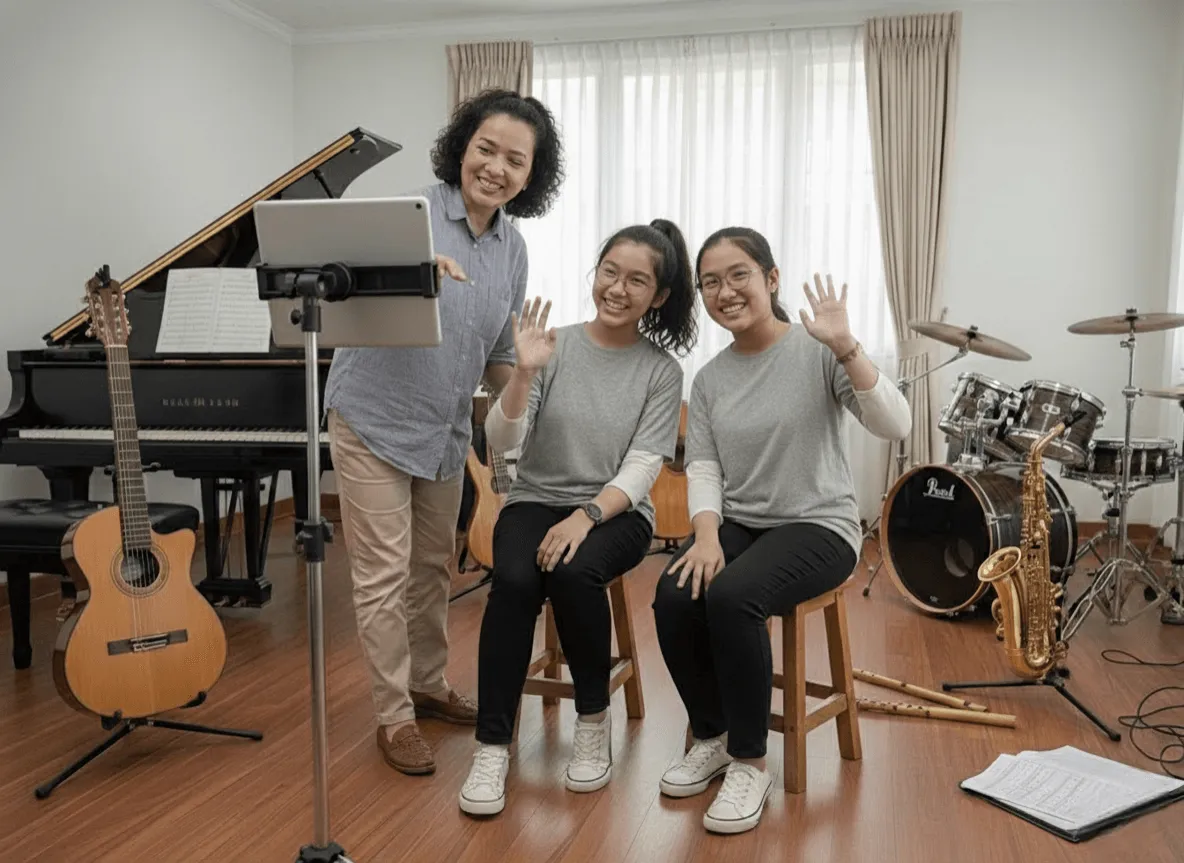
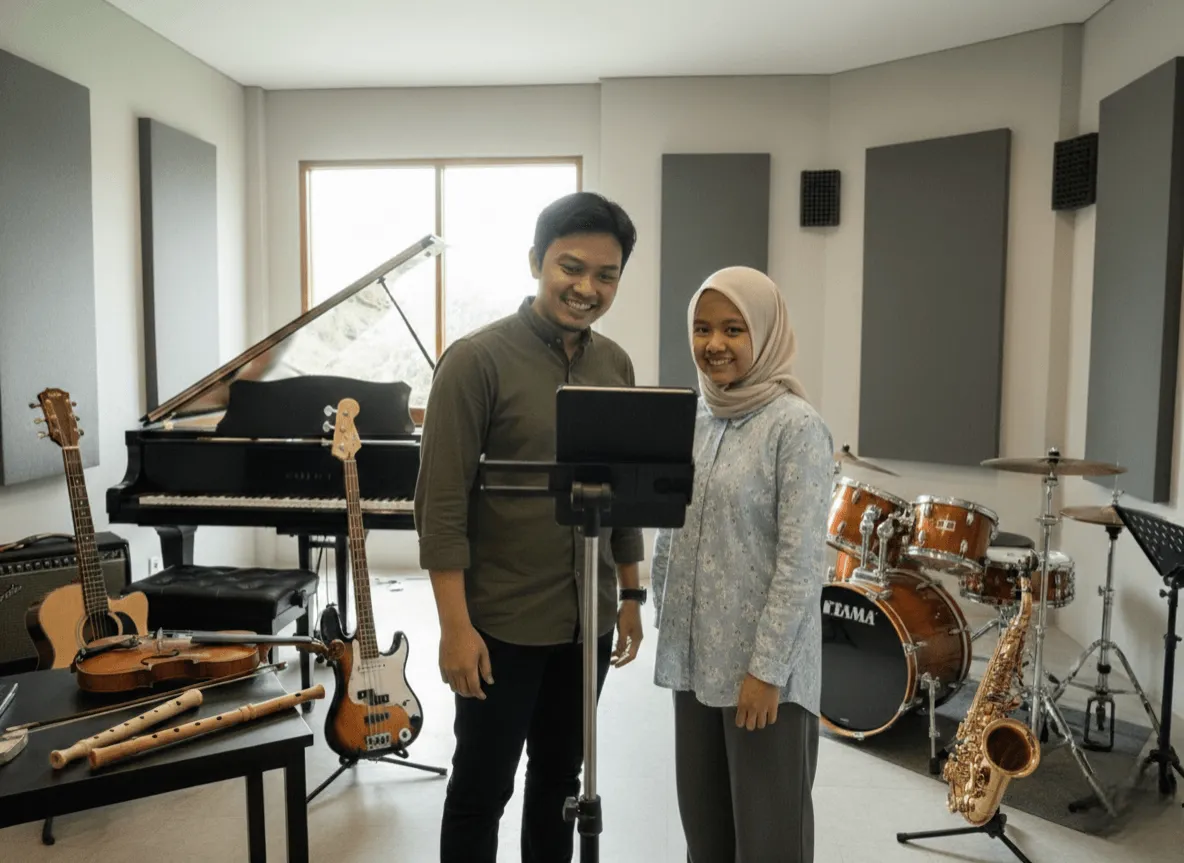
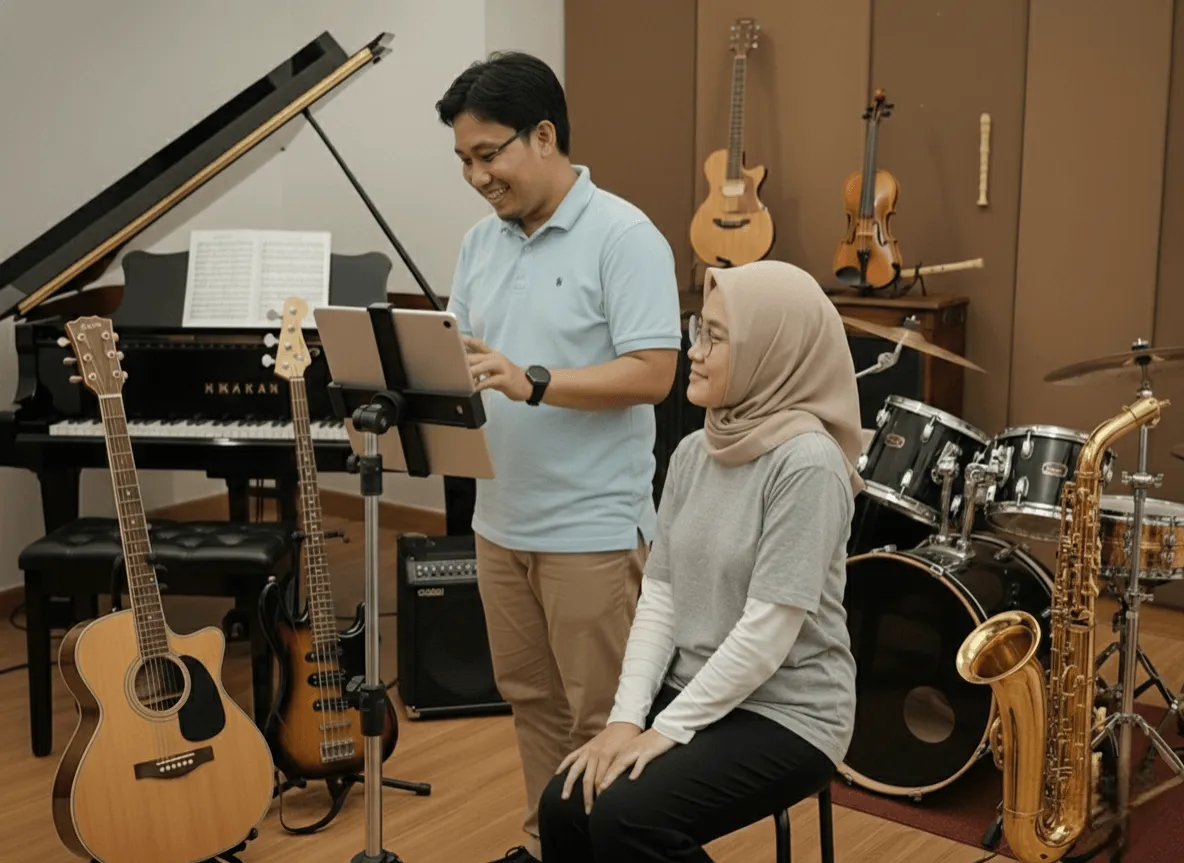
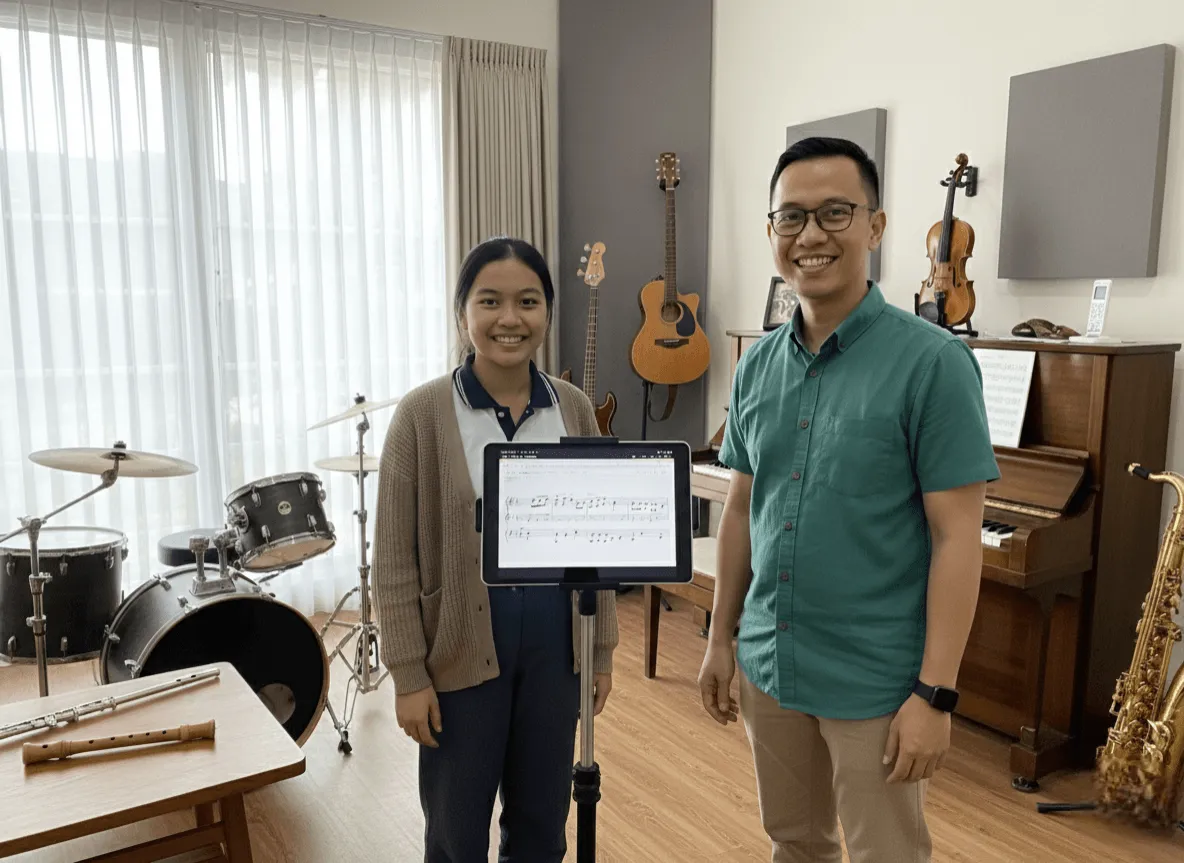
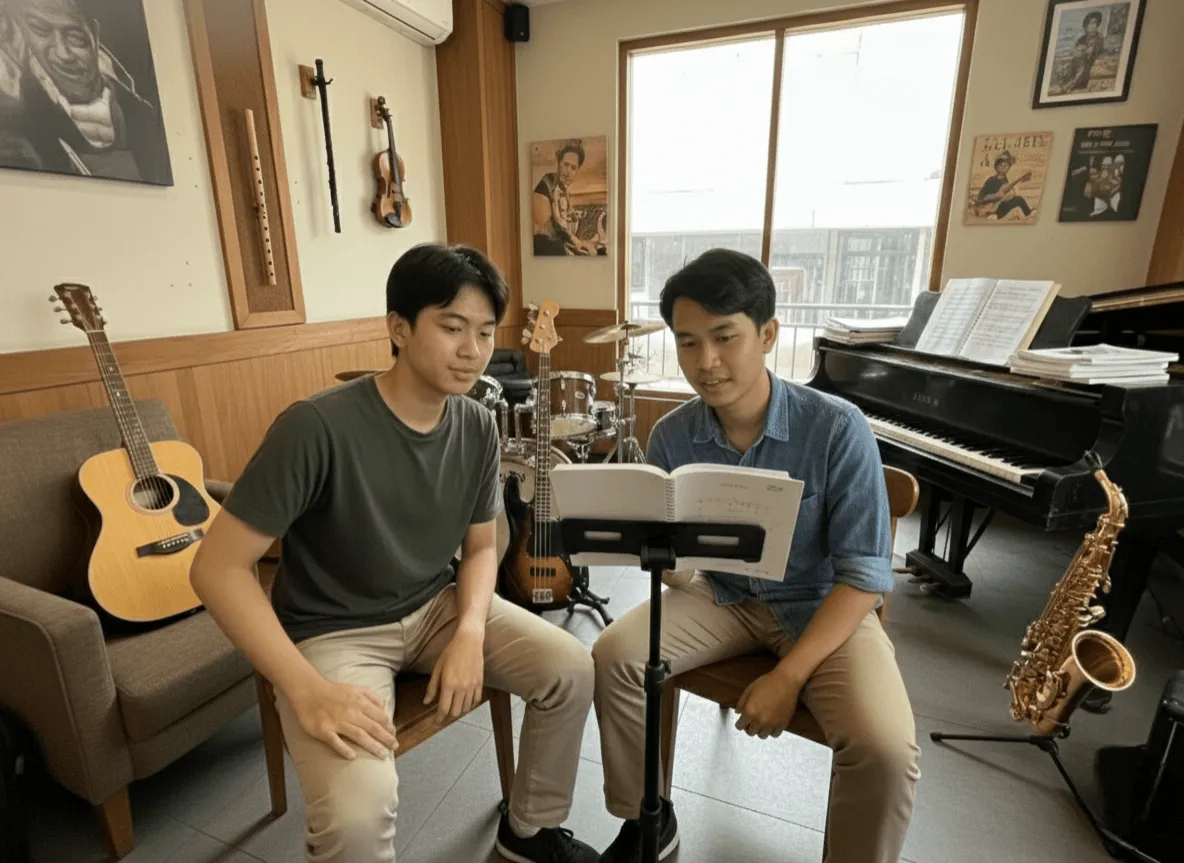
The photographs below were taken during music tutoring in Bali sessions with learners on the island.
Service Area
Where Edupola Music Tutors Travel in Bali
Music teachers come to the location you choose in Bali, from Denpasar, Badung, and Gianyar through to Tabanan, Buleleng, Klungkung, Bangli, Karangasem, and Jembrana. Lessons sit wherever the instrument sits, which for most learners means home, and the room needs enough quiet for the learner to hear themselves.
The instrument decides the match. Guitar, piano, and vocal are taught by most tutors; violin, drums, and brass by fewer, so learners wanting those sometimes wait a little longer for the right person. Learners preparing a graded examination are matched to tutors who teach that syllabus, since the requirements differ between boards.
The Edupola office is not used as a lesson venue. Where no tutor is available near you, sessions run online. Some instruments transfer online better than others, as the next section explains. Ask the admin about tutor coverage at your location in Bali.
Online Sessions
Online Sessions in Bali and the Instruments That Suit Them
Online sessions for music tutoring in Bali run over Zoom or Google Meet, and the instruments divide honestly. Piano, keyboard, and guitar work well, since the hands and the instrument fit in one camera frame and the sound survives compression reasonably.
Drums and voice are the hardest. Call audio compresses dynamics, which is precisely what a tutor listens for in both, so learners on those instruments record a phrase properly and send the file. Violin sits in between: intonation can be judged on a recording but not reliably in a live stream.
What transfers regardless of instrument is the shared foundation: beat work, notation, counting bars, harmony, and the practice plan. Learners outside tutor coverage often alternate, taking the theory and reading online and the instrument-specific work in person every few weeks. Fees for online sessions match face-to-face sessions.
Frequently Asked
Questions From Music Learners
What does private music tutoring in Bali cost?
Fees start from IDR 120,900 for a 60-minute session, the shortest option. Sessions of 90 and 120 minutes are available with the fee following the length. The final fee follows session length and the number of sessions per month, between 4 and 28. The admin sends the breakdown in writing before the first payment. An instrument, a metronome application, and sheet music are the learner's responsibility and not included in the fee.
Which instrument is easiest for a beginner?
The question has no useful answer, because every instrument is easy for a fortnight and has a wall in the second month. The walls are differently shaped instead of differently sized: guitar stalls at chord changes, piano at hands doing different things, violin at intonation. What predicts whether a learner continues is wanting to play specific songs, so the song list chooses the instrument.
Do I need to buy an instrument before starting?
No, and buying before the consultation is how learners end up with the wrong one. Borrowing or renting is fine for the first months. Once the instrument is decided, the tutor says what to watch for in your price range, including the two things people get wrong: size for children and the noise it will make in your house.
My child does not know which instrument they want. How is that handled?
The first session starts from songs instead of instruments: what the child listens to and what they want to be able to play. The tutor then demonstrates two or three candidates and watches which one the child keeps reaching for. Noise and size narrow the list before that, since an instrument that cannot be practised at home will not be learned.
How long before I can play a whole song?
Weeks, because the first piece is deliberately simplified until it is reachable. Finishing something early is what converts curiosity into a practice habit, so tutors prefer giving a learner a complete simple piece to half of an impressive one. Polish and difficulty both come later, once the daily habit exists.
How is a music tutor matched to a learner?
The schedule is settled first during the consultation, covering days, times, session length, and sessions per month. The Edupola team then looks for a tutor whose travel to your location in Bali stays short, and that search runs 1 to 5 working days. The instrument decides the match here, and graded examination candidates are matched to tutors who teach that syllabus. If the first 2 weeks feel like a poor fit, a replacement is arranged at no extra cost.
Related Programmes
Single-Instrument Programmes in Bali
Once the instrument is chosen, learners usually continue in the programme for that instrument.
-
Guitar Tutoring in Bali
For learners whose song list points at chords and accompaniment.
-
Piano Tutoring in Bali
For learners who want to read and play melody with both hands.
-
Vocal Tutoring in Bali
For learners whose instrument is already with them.
Get Started
Start From the Song That Makes You Want to Play
Name two or three songs you are aiming at, what instrument you can get hold of, and how many minutes a day you can practise. A tutor in Bali is matched within 1 to 5 working days.