
Private Swimming Lessons in Bali
Swimming Lessons in Bali: From Fear to Four Strokes
Swimming lessons in Bali from Edupola pair one instructor with one learner at a pool near you. Learners who are afraid of water are not rushed past it. The first thing settled is breathing, because panic begins there and not in the arms, and 4 strokes come later. Fees from IDR 136,200 per session.
Rating and fees for swimming lessons in Bali
| Programme | Swimming Lessons in Bali |
|---|---|
| Provider | Edupola |
| Description | Private swimming lessons in Bali, one instructor per learner, at a pool near you: water adaptation, the basic strokes, the harder strokes, then competition or rescue skills. |
| Fee | Fees start from Rp136,200 per session. |
| Session Length | Every session runs 60, 90, or 120 minutes. |
| Schedule | Flexible, following the learner's free hours. |
| Start | Enrolment is open year round. |
| Sessions per Month | 4 to 12 sessions per month, as needed. |
| Rating | 4.8 out of 5, based on 168 reviews |
Programme at a Glance
Swimming Lessons in Bali for Children and Adult Beginners
Swimming lessons in Bali runs one tutor with one learner, at a pool near you. A fair share of learners here are adults who never learned, and the programme is built so that admitting it costs nothing.
The order of teaching follows where panic actually starts. Not the arms and not the legs: the breath. A learner who cannot exhale calmly with their face in the water will tense every muscle, sink their hips, and conclude they are too heavy to float. Teaching a stroke on top of that produces a frightened person moving their arms quickly.
So breathing and floating come first, for children and adults alike, and the strokes follow once the water has stopped being an emergency. The programme covers water adaptation, the basic strokes, the harder strokes, and competition or rescue work for learners who need it. Fees start from IDR 136,200 per 60-minute session, with 4 to 28 sessions a month. This programme holds a 4.8 out of 5 rating across 168 learner reviews in Bali.
The Pool
Which Pool the Lessons Use
Lessons need water, and swimming lessons in Bali uses whichever pool the learner can reach easily and reach repeatedly. Three arrangements cover almost everyone: a pool at the learner's own home or villa, a pool at their housing complex, or a public pool near them.
The choice matters more than it sounds, for a reason that has nothing to do with comfort. Progress in this subject comes from frequency, and frequency collapses when a lesson involves forty minutes of traffic each way. A nearer pool with worse facilities beats a better pool across the island almost every time.
One more thing is decided with the pool and it is specific to Bali: salt water or fresh. Some villas and beach clubs in Bali run salt pools, which sting the eyes less and change buoyancy slightly, so a learner who trains in one and then swims in the other notices it. The teaching is identical, and saying it in advance stops a first session in a different pool from feeling like a setback.
Two practical points are settled before the first session. Entry fees at a public pool are paid by the learner, and they are named in advance so nothing is a surprise. And depth is checked against the learner: a beginner needs water they can stand up in, which rules out some otherwise convenient pools for the first weeks.
Levels
Swimming Levels and What Each One Contains
The swimming level a learner starts at is set by what happens in the water in the first session, and never by their age.
-
Level 1
Water Adaptation
Breathing out with the face in the water, floating, and standing up again without help. Nothing resembling a stroke, and this is the level that decides whether everything after it works.
- Exhaling in water
- Floating
- Standing up unaided
-
Level 2
The Basic Strokes
Front crawl and breaststroke, with breathing built into the rhythm instead of added afterwards. Most learners who wanted to swim for fitness stop comfortably here.
- Front crawl
- Breaststroke
- Breathing in rhythm
-
Level 3
The Harder Strokes
Backstroke and butterfly, where timing matters more than strength. Learners often find backstroke easier than expected and butterfly harder, and both are normal.
- Backstroke
- Butterfly timing
- Turns
-
Level 4
Competition and Rescue
Starts, turns, pacing, and open water skills, or survival and rescue work for learners who need a certification. Taken by a minority and planned against a date.
- Starts and pacing
- Open water
- Rescue skills
Stroke Map
What Each Stroke Trains and Where It Goes Wrong
Swimming instructors use this to sequence a learner. The third column is the error that appears most often in that stroke, and it is corrected before speed is added.
| Stroke | What is trained | The error that recurs |
|---|---|---|
| Front crawl | Body line, rotation, and breathing to one side | Lifting the head to breathe, which sinks the hips immediately |
| Breaststroke | Timing of pull, breath, kick, and glide | Pulling and kicking together, which cancels both |
| Backstroke | Straight body line and a steady kick | Sitting in the water, so the hips drop and the legs drag |
| Butterfly | Rhythm between hips and arms | Using the arms for power, which exhausts a swimmer in a length |
| Survival floating | Staying calm and afloat without moving much | Treating it as exercise, which burns the energy it exists to save |
Water Safety
Six Water Skills Trained Beyond the Strokes
These are taught to every learner regardless of level, and in Bali they matter as much as the strokes do.
-
Floating and Settling Down
Getting to a float in Bali water and staying calm there. It is the single most useful skill in the water, and it is what buys time in every situation that goes wrong.
-
Managing Breath at the Surface
Breathing in a chop instead of in flat water, which is the usual sea state around Bali, where a mouthful arrives unexpectedly. Practised deliberately, because the sea around Bali is rarely flat.
-
Entering and Leaving Safely
Getting in feet first in unknown water, and getting out at a wall or a ladder when tired. Most pool injuries happen in these two moments.
-
Knowing Your Own Limit
Judging how far you can swim in Bali water and still return, which is a learned estimate and not a feeling. Taught explicitly to adults who swim alone.
-
Using Flotation Correctly
What a float does and does not do, including why an inflatable toy is not safety equipment. Parents are included in this part.
-
Helping Without Drowning Too
Reaching, throwing, and calling instead of swimming out. The instinct to swim to someone is what makes rescuers casualties, and it is corrected by rehearsal.
One Session
Inside a 60-Minute Session at the Pool
This is the division used at the pool. The poolside warm-up is never skipped, however keen a learner is to get in.
-
5 minutes
Warm-Up at the Poolside
Shoulders and ankles loosened out of the water. Cold shoulders in a crawl stroke is how adult learners acquire the injury that ends their lessons.
-
10 minutes
Revisiting the Last Movement
Whatever was worked on last session, repeated before anything new. Water skills decay faster between lessons than most learners expect.
-
20 minutes
Technique Practised Apart
One element on its own: the kick with a board, the arm alone, the breath alone. Isolating it is what lets a learner feel the change.
-
20 minutes
Joining the Movement Together
The element put back into the whole stroke, slowly. Slow swimming is harder than fast swimming and it is where technique actually settles.
-
5 minutes
Cooling Down and Notes
Easy movement, then two sentences on what to think about next time. For children, those sentences go to the parent as well.
In a 90 or 120 minute session, a longer session covers distance work or open water practice, which is what learners training for a competition or a triathlon usually choose.
Brought by the Learner
What the Learner Brings to the Pool
The admin confirms these once the schedule for swimming lessons in Bali is agreed. Swimwear, goggles, a cap, and any pool entry fee are prepared by the learner and not included in the fee.
-
Swimwear That Fits
Close fitting, not loose. Loose clothing drags in the water, which makes a beginner feel heavier and slower than they are and feeds exactly the wrong conclusion.
-
Goggles
The single item that changes a beginner's first session most. Being able to open the eyes underwater removes a large part of the fear, and chlorine stops being a reason to surface.
-
A Cap and a Towel
A cap keeps hair out of the face, which matters more than vanity: hair across the eyes while learning to breathe to the side is enough to break the rhythm.
-
Access to the Pool at That Hour
Confirmed in advance, including whether lanes are reserved. A session that arrives to find a swimming club occupying the pool loses the hour.
-
Any Health Information
Asthma, ear problems, epilepsy, heart conditions, or recent surgery. The instructor adjusts the session and needs to know before the first entry into the water.
If the learner is afraid of water, say so during the consultation. It changes who is matched and how the first session runs, and it is the most common thing people hesitate to mention.
How Long
How Long Before One Stroke Can Be Swum
For a child with no fear of water, one stroke across a short pool usually arrives within eight to twelve sessions of swimming lessons in Bali. For an adult beginner the range is wider, and almost all of the variation sits in the first level instead of in the stroke itself.
That is the part worth understanding before starting. A learner comfortable putting their face in the water progresses quickly, because the strokes are a motor skill and motor skills respond to repetition. A learner for whom the water is still an emergency can spend several sessions on breathing and floating alone, and those sessions are what makes the rest possible.
Frequency decides more than talent. Two sessions a week progresses roughly twice as fast as one, and not because of the extra hour: skills in water decay between lessons, so a weekly learner spends part of each session recovering what the previous week already had. Families who can manage two shorter sessions are usually advised to do that instead of one long one.
What Learners Say
Stories From Swimming Learners in Bali
The quotes below come from learners in Bali who completed the swimming programme at Edupola, with their situation and what changed.
-
★★★★★
My son was very afraid of water and used to cry when we went to a pool. The Edupola instructor was extremely patient, starting with games.
A child who feared water now swims on his own
Dharma P.
Parent of a 7-year-old boy · Verified learner
-
★★★★★
I had been afraid of water since childhood and was embarrassed to admit I could not swim as an adult. My Edupola instructor never judged me.
Overcame a fear of water and swims independently
Ratih K.
Adult beginner, aged 35 · Verified learner
-
★★★★★
My Edupola coach concentrated on my butterfly technique, which was inefficient. With video analysis I could see the errors myself.
Provincial gold in freestyle
Yoga P.
Junior swimmer, aged 14 · Verified learner
-
★★★★★
I took semi-private lessons with both my children. The instructor taught the three of us patiently, each at our own level.
A mother and 2 children now swim together
Ayu L.
Parent learning alongside her children · Verified learner
-
★★★★★
Swimming was my weak point in triathlon. Edupola helped me improve my open water technique, sighting, and drafting.
Finished a first triathlon at a competitive swim pace
Surya W.
Amateur triathlete · Verified learner
-
★★★★★
As hotel staff with a beach club I am required to have water rescue skills. Lessons at Edupola prepared me with the survival skills needed.
Passed a water safety certification
Dewi A.
Five-star hotel staff · Verified learner
How to Register
Four Steps to the First Session at the Pool
The opening consultation carries no fee. The admin asks which pool you can reach and what happens when you are in water.
-
Decide the Pool
Your own pool, one at your complex, or a public pool nearby. Reachability decides this, because frequency decides progress.
-
Agree the Schedule
Days, times, session length, and sessions per month are agreed with the admin, following the hours the pool is quiet and the learner has energy, which for children is rarely after school.
-
Matching the Instructor
The team looks for a tutor whose travel to your location in Bali stays short, and that search runs 1 to 5 working days. Learners afraid of water and competition swimmers are matched to instructors who do that specifically.
-
The First Session
Breathing and floating are assessed in water the learner can stand up in, and the level is set from what happens there.
Need help? Contact our admin on WhatsApp for a free consultation.
Documentation
Swimming Lessons With Edupola in Bali
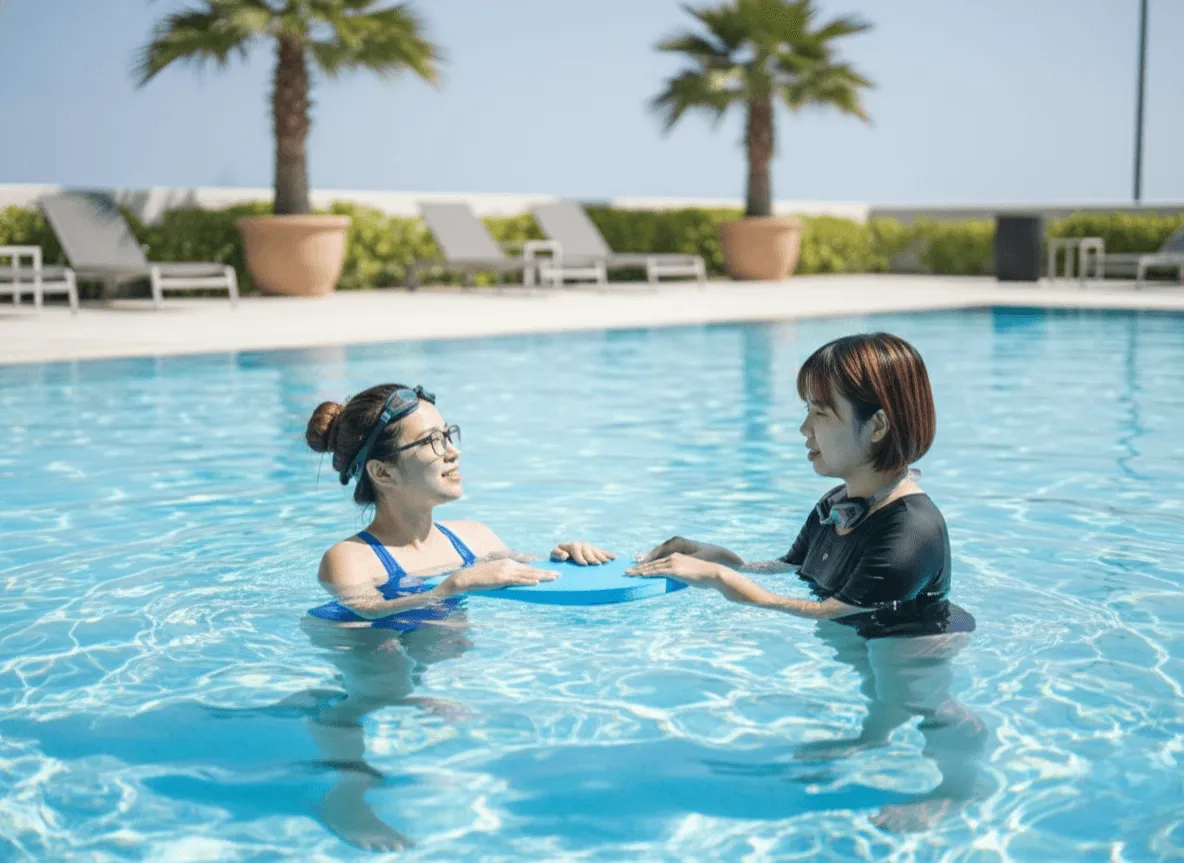
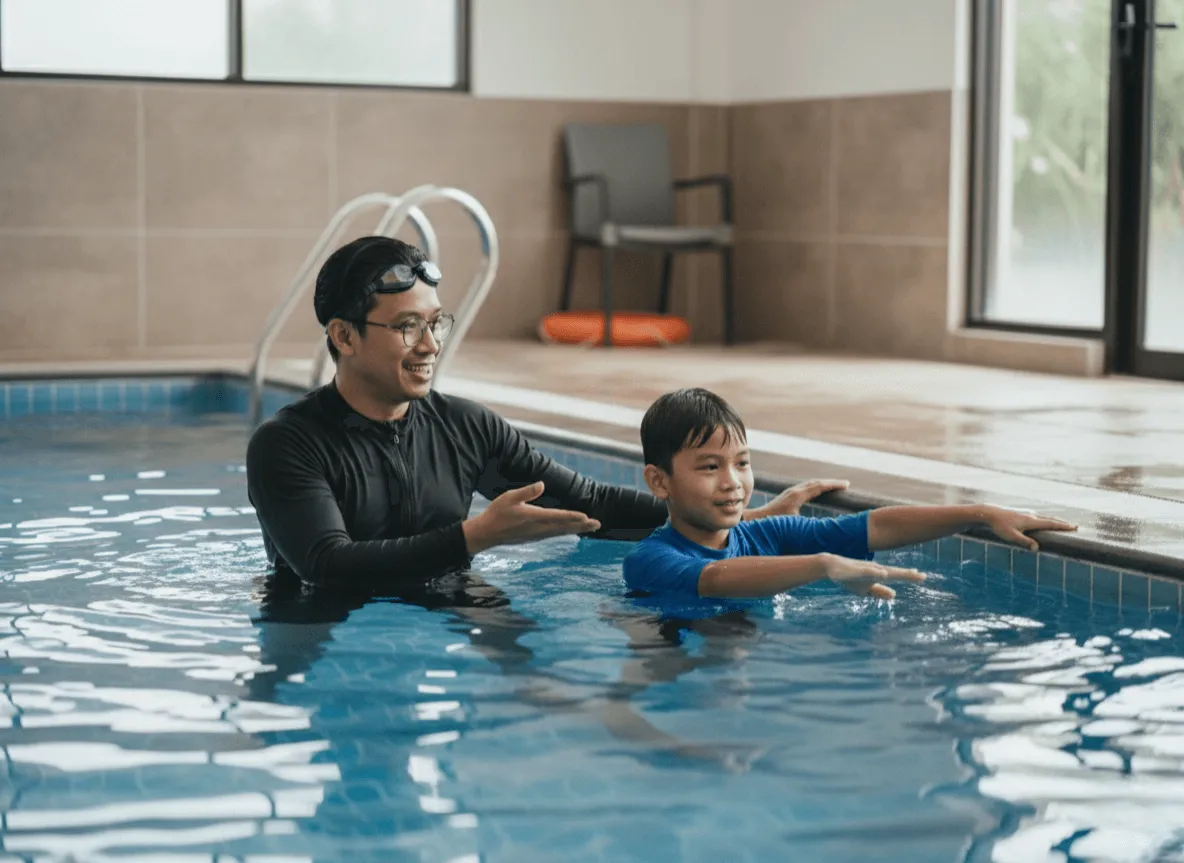
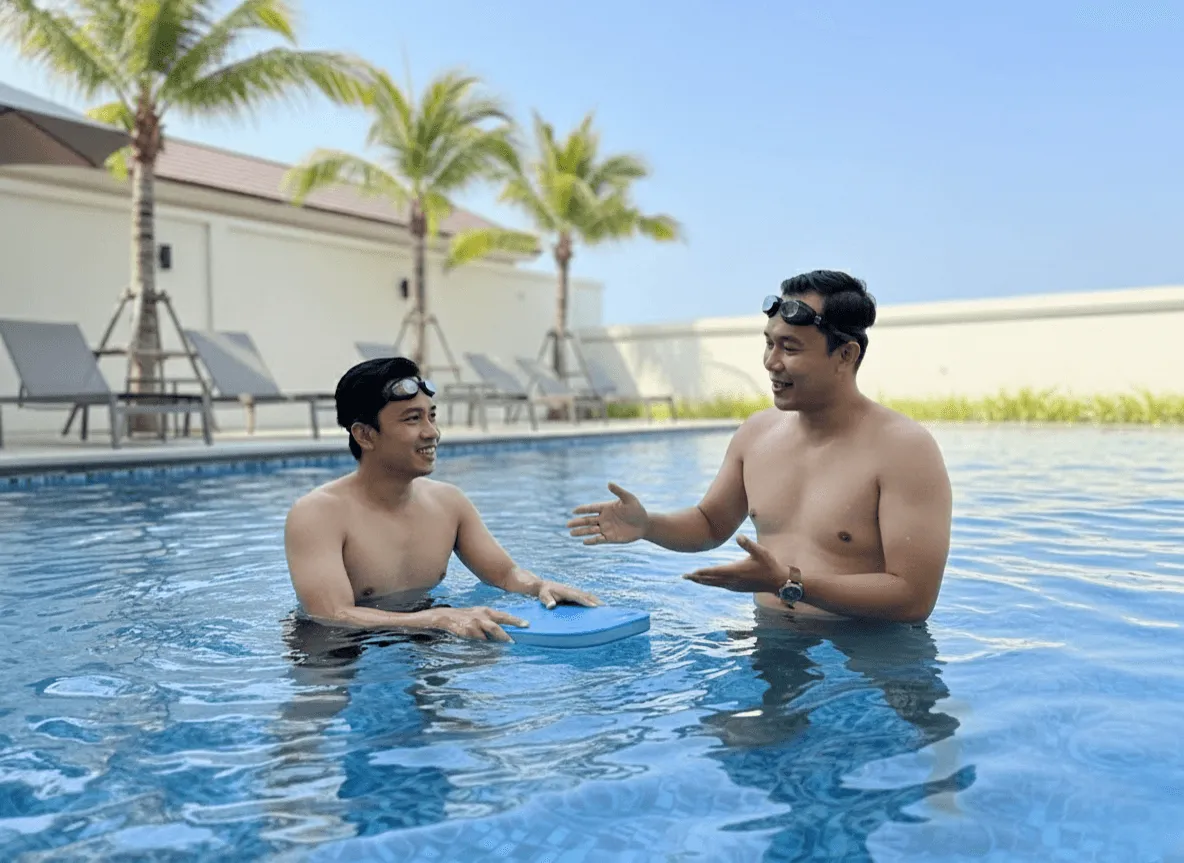
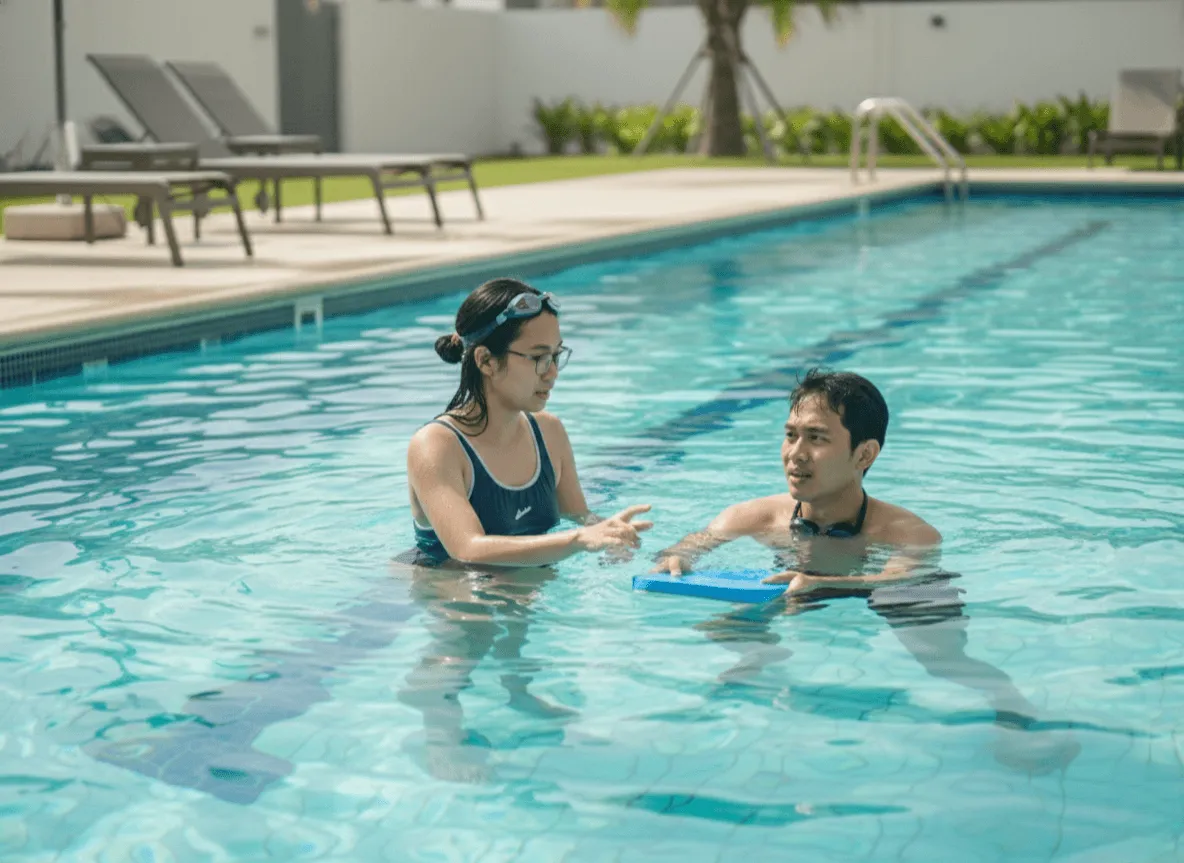
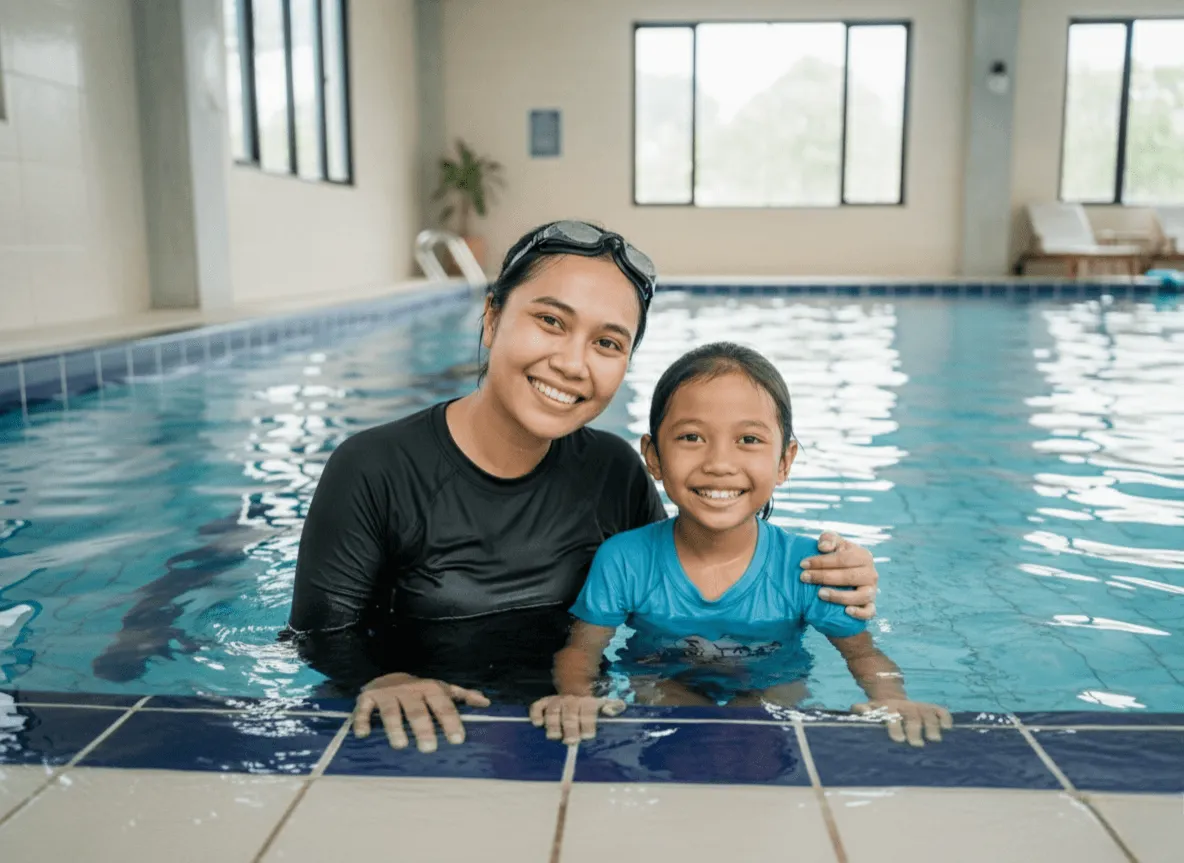
The photographs below were taken during swimming lessons in Bali sessions with learners on the island.
Service Area
Where Edupola Swimming Instructors Travel in Bali
Instructors for swimming lessons in Bali travel to a pool you can reach, across Denpasar, Badung, and Gianyar through to Tabanan, Buleleng, Klungkung, Bangli, Karangasem, and Jembrana. What matters is the water, and whether you can get to it weekly without a long drive.
Two things shape the match besides distance. Pool access at the hour you want, since public pools in Bali have club bookings and school sessions that take whole evenings. And the instructor's specialism: a learner afraid of water, a child starting out, and a triathlete fixing open water technique need three different people.
The Edupola office is not a lesson venue and there is no Edupola pool. Online lessons exist for other Edupola programmes and swimming is not among them, for the obvious reason: the water cannot be shared through a screen. Ask the admin about instructor coverage and pool options at your location in Bali.
Frequently Asked
Questions From Families About Swimming Lessons in Bali
What does private swimming tuition in Bali cost?
Fees start from IDR 136,200 for a 60-minute session, the shortest option. Sessions of 90 and 120 minutes are available with the fee following the length. The final fee follows session length and the number of sessions per month, between 4 and 28. The admin sends the breakdown in writing before the first payment. Swimwear, goggles, a cap, and any pool entry fee are prepared by the learner and not included in the fee.
Does the learner need their own pool?
No, nobody in Bali needs their own pool. Three arrangements cover almost everyone: a pool at your home or villa, a pool at your housing complex, or a public pool near you. Entry fees at a public pool are paid by the learner and named in advance. What matters is reaching the water weekly without a long drive, since frequency decides progress more than the quality of the pool does.
At what age can a child start swimming lessons?
From around 4 in Bali as anywhere, when a child can follow a short instruction and stand in shallow water, with sessions kept short at that age. Before that, water familiarity with a parent in the pool is more useful than lessons. The first session works in water the child can stand up in, and the level follows from what happens there.
Can an adult who is afraid of water learn?
Yes, and a fair share of learners in Bali are exactly that. The fear is not rushed past: breathing out with the face in the water and floating come first, in water you can stand up in, for as many sessions as it takes. Instructors who work with nervous adults are matched specifically, and saying so during the consultation changes who you get.
What needs to be brought to the pool?
Close-fitting swimwear, goggles, a cap, and a towel, whichever pool in Bali you use. Goggles make the largest difference to a beginner, because opening the eyes underwater removes much of the fear. Also bring any health information: asthma, ear problems, epilepsy, heart conditions, or recent surgery all change how the session runs and the instructor needs them beforehand.
How is a swimming instructor matched to a learner?
The schedule is settled first during the consultation, covering days, times, session length, and sessions per month. The Edupola team then looks for a tutor whose travel to your location in Bali stays short, and that search runs 1 to 5 working days. The specialism matters here: nervous adult beginners, young children, and competition swimmers are matched to different instructors. If the first 2 weeks feel like a poor fit, a replacement is arranged at no extra cost.
Related Programmes
Other Programmes Swimming Learners Add in Bali
Learners taking swimming lessons in Bali often add one other programme, usually once they are comfortable in the water.
-
Sports Tutoring in Bali
Taken by learners building general fitness alongside the swimming.
-
Martial Arts Tutoring in Bali
Chosen by families who want a second physical discipline for a child.
-
Dance Tutoring in Bali
Often added by learners who enjoy movement and want it set to rhythm.
Get Started
Start From the Nearest Pool
Tell us which pool you can reach, the learner's age, and what happens when they are in water. A tutor in Bali is matched within 1 to 5 working days.